Showing posts with label Philosophy. Show all posts

Friday, October 28, 2016

Japan, observations

I'm a mad dasher, I might as well admit it. I'm more comfortable running around, packing in the activities, losing myself in action. When I wake, I feel an urge to move, the stress of stillness...

Eerily quiet on the Hibiya line. Not a single voice heard in the packed subway car station after station. A girlish utterance absorbs into unforgiving human forms. What are these clean, self-contained, silent individuals on the express train thinking about this weekday morning...

The girl powdering her cheeks and limning her eyes smiling happy in her pouty prettiness. The guy massaging his temples. The advertisement banners hanging down from the center roof of the train that would never fly in New York; people'd put their heads through the paper ads like door curtains. The little subway dance, when someone needs to disembark around you, and you have to shuffle with tiny steps, like dancing with a six-year-old. People are more careful, quiet, and considerate here. Less of the closed-in fear and stressful almost-shoving induced by seemingly imminent door closings. I lean against the ‘back’ door and then it opens at the next station. An unexpected reversal. My logic proved faulty. Touché, subway...

What Manami said: there are two Japan's. Tokyo is not Japan!...

Japan, even Tokyo, is more structured and ordered . There's less of the disordered vibrancy that characterizes America; also called diversity or mix or "low" culture. Consider the ubiquitous umbrella, the occasional parasol...

Perfectionism is the opposite of fatalism...

Onsen tubs. Reed brooms. Raised train lines. Sea to mountain declines. Street fair food stalls. Monstrous insects. Sylvan shrines: Miyazaki...

At 5pm exactly monks ring temple bells all through Kyoto and people leave offices. Sidewalks throng with men and women in formal wear and black shoes. In some quarters, some women wear kimonos, white socks, wood sandals. They nod to smartphones waiting for the light to change...

The assumption now is that travelers will go on, are in the middle of long-term vagabondings. It wasn’t always like this. I remember the first time I heard about someone picking up and running off, how it surprised and titillated me. Now it's par for the course. Ever more wanderers...

Back at the hostel, the Italian says, “Where can I go to meet the girls!,” laughing and leering at the young Japanese woman, Siuri, staffing the hostel at 10pm. She’s says, “Why are you laughing? Haha. Too Italian!”...

Monstrous coy and carp jockey for position in the park pool. Feed me!...

I'm going to see some thing. I'm already imagining taking photos of the thing, showing those photos to other people, and how they will react to the photos. A mind divided upon itself will fall...

The vampire of regret sucks joy out of the present...

I grasp my walking stick and plan each foot-plant on the mountain trail. The wind blows the tree-tops; I think the trees are breathing. I follow their lead, take a deep breath and then another. I think, “The forest teaches you things. How to breathe, how to be patient, present...”—I blunder face-first into a spider web, drop my stick, and clutch face and hair in mortal fear...

Saturday, December 13, 2014

Technological travails

Life has taken a sharp turn for the worse. I've been in a Stop n' Shop for about 2 hours. Ideally I'd never enter a Stop n' Shop or a Walmart or a McDonalds, among other omnipresent, obtrusive centers of commerce and diabetes. Stop n' Shop isn't even all that bad; it's more a matter of principle.

Nonetheless, I ended up here. What happened is this: I screwed up synching my iPhone with iTunes and, since I don't have wifi at my apartment, I had to venture forth to restore the phone's operating system. Stop n' Shop boasts wifi internet and Starbucks and cookies so here we are.

Then when the restore was on the cusp of completion, the computer lowed an emergency low battery distress signal and summarily died. Devastation! I had to restore the blood sucker and re-synch all of everything and I'm mid process. My life resides on that devilish device.

All of this has served to remind me why I don't have wifi in the apartment in the first place: technology--at least high technology--does not by and large make my life easier, let alone better.

It does, but it doesn't. I must, as always, blame myself first and foremost. I am me. And I am not an adept, precise, or meticulous problem solver when it comes to technological complexity. I'm all thumbs. My neurons are wearing oven mitts.

I believe this is because I harbor a more romantic, synthetic, gestalt-based sensibility. I mean, I want things to work and be beautiful. I want beauty to surge muse-beckoned out of my pure and unhindered soul. Things should work, should they not? I'm no concrete, technological, engineering, analytical fixer. I can't fix a chicken sandwich let alone a faulty circuit or corroded whatsit. Thus, rather than master my technology my technology masters me.

This may be a tolerable state of affairs. It depends on what I'm aiming to optimize for: poetry, motorcycle maintenance, financial analytics, journalism, funk music, teaching, child rearing. What do I want, and what do I want to do, and what do I want to do well?

I need to iron out the factors in production here, because it's not like understanding the technical, analytical relationship between factors in a poetic form inhibits poetic expression. Perhaps the dichotomy is false and quality inheres in a fusion. Let's see if unstructured intuitive creativity will solve this.
***

PS I hate how Facebook pushes its push notifications and friend lookup and other crappy crap. It's basely procreative but annoying nonetheless. And YouTube commercials now induce in me a rage that's rapidly overwhelming any pleasure I get from the site's music, comedy, Ted Talks and junk. And what about the latest iTuneses? Insidious monstrosities that make me want to commit technical seppuku. Someone save me from these technology travails

Thursday, April 26, 2012

Id for ideas? (no Freud at all)

Do ideas excite you?
Do they drive you
like a bullock whip
Or pull you
Like a magnet?

Are ideas internal
Possessing intrinsic
effervescence, velocity?,
Personal vectors
Of being and doing?

Are they social fodder
For connection
And contestation,
Lubricants of the day to day.
Are we ideational men and women?

Are ideas higher or more
Than other things?
More vital, noble, profound,
Unadulterated or distilled,
Disconnected?

What are ideas anyway?,
If anything at all,
What do they touch?
Where do they fit?
And what are they not?

Ideas are not deities,
(But maybe vice versa),
Nor material or palpable things,
Like viscera
And stock options.

They could be science,
After our knowledge alembic,
But may be more aesthetic,
Like bird's songs,
Possessing singular transience.

Ideas are probably relations,
By virtue of binding,
And almost definitely information,
Bits, that is, guiding
For instance, geese to migration.

Ideas might be
more like instruments than songs
For a role in achieving.
Or perhaps ideals
Infinitely reaching.

But do ideas excite you?
Or does some other thing?
Baser and simpler
Impulses and incentives,
With which we're all familiar.

Money is motivating,
Profane and material.
But without nutrition,
Vacuously instrumental,
For what, for what?

Maybe hedonism helps,
Ideas with directives:
All voluptuous things.
But lamentably tempered
by treadmills and falling returns.

We'd shelter in
Basic needs satisfaction
If it weren't so human
To want more and higher
Forms of gratification.

What then are these more-wanting
and demeaning returns,
If not ideas as natural laws?,
However contingent and uncovering,
Are ideas also governing?

Whatever it is they are or do,
Do ideas excite you?
Are you even excited?
I won't blame you
If you're not.

Wednesday, March 28, 2012

Quotations: invention, imitation, transposition

Randy Cohen: What is benign in one setting can be toxic in another. (Chainsaws: useful in the forest, dubious at the dinner table. Or as Dr. Johnson put it in a pre-chainsaw age, “A cow is a very good animal in the field; but we turn her out of a garden.”) (*)

Malcolm Gladwell: "I have two parallel things I'm interested in: collecting interesting stories and collecting interesting research. What I'm looking for is where they overlap."

Jean-Luc Godard: It’s not where you take things from—it’s where you take them to.

Jonathan Lethem: Any text is woven entirely with citations, references, echoes, cultural languages, which cut across it through and through in a vast stereophony. The citations that go to make up a text are anonymous, untraceable, and yet already read; they are quotations without inverted commas. The kernel, the soul--let us go further and say the substance, the bulk, the actual and valuable material of all human utterances--is plagiarism. For substantially all ideas are secondhand, consciously and unconsciously drawn from a million outside sources, and daily used by the garnerer with a pride and satisfaction born of the superstition that he originated them; whereas there is not a rag of originality about them anywhere except the little discoloration they get from his mental and moral caliber and his temperament, and which is revealed in characteristics of phrasing. Old and new make the warp and woof of every moment. There is no thread that is not a twist of these two strands. By necessity, by proclivity, and by delight, we all quote. Neurological study has lately shown that memory, imagination, and consciousness itself is stitched, quilted, pastiched. If we cut-and-paste our selves, might we not forgive it of our artworks? "The Ecstasy of Influence" Harper's Magazine, Feb. 2007, p. 68.

Pablo Neruda: "Writers are always interchanging in some way, just as the air we breathe doesn’t belong to one place. The writer is always moving from house to house: he ought to change his furniture. Some writers feel uncomfortable at this. I remember that Federico García Lorca was always asking me to read my lines, my poetry, and yet in the middle of my reading, he would say, “Stop, stop! Don’t go on, lest you influence me!" (Paris Review, The Art of Poetry 14)

Isaac Newton: "If I have seen further it's by standing on ye shoulders of Giants," in a letter to Robert Hooke

John Padgett and Woody Powell: Emergence of novelty is not virgin birth. Everything, even the origin of life itself, is a combination and recombination of other things in its accessible context... Understanding the emergence of objects, therefore, is a matter of deconstructing objects into the transformational flows that construct and sustain them. Viewed from the perspective of flows, objects are the folding and refolding of their context – namely, of the ecology or network of other objects with which those objects interact... For example, stability of the human body through time means not mechanical fixity of parts; it means organic reproduction of parts in flux. Viewed as chemical reactions, we are vortexes in the material life that wends through us all. (*) (forthcoming The Emergence of Organizations and Markets, Princeton U. Press)

Janwillem van de Wetering: The Daimyo : "What would I be? A good question. I have no answer. My mind is clouded by the countless thoughts with which I have identified myself and which have all left their traces." (*) (an interview)

Harrison White: You can be assured that, for each idea, quite a number of substantial, and often independent, discussions and implementations could be cited: Ideas that have any importance, any impact, do, after all, come in company, not as isolates, and the essayist is mostly a transcriber of ideas abroad in his networks" (1994a, p. 4) in Emirbayer 1997

Eric Hoffer: Total innovation is a flight from comparison and also from imitation. Those who discover things for themselves and express them in their own way are not overly bothered by the fact that others have already discovered these things, have even discovered them over and over again and have expressed what they found in all manner of ways. 1960, from his notebooks.

The Books:


Wednesday, February 15, 2012

The fallacy of the unbounded

Allow me to take a stroll down memory lane.

Originally, "The Unbounded One" was a radio show and personality: my show, my personality on WERW 1570 AM and Internet Radio and later WAER 88.3 FM, Syracuse, and WHPK 88.5, Chicago.

I invented the moniker and intended it from the first to have a double significance, to refer to me, given my dedication to world music, and also to the immanent one, the totality of the world itself.

Immanence is a concept referring to presence manifested within, contained within, and intermingling with. In philosophy a mental act is immanent if it stays within the mind; if it passes through the mental barrier to make an external effect, it is transeunt. In religion, the deity is immanent, as opposed to transcendent, if it is indwelling in the universe, time, life, etc.

So the show featured two Unbounded Ones fused into one: me and a global omnium gatherum, each inherent to the limitless and immanent world.

A most perfect and mysterious thing to which I assign considerable credence seems to be the entire universe. A most unperfect and not-too mysterious thing is the human being. How to make the human being more like the universe without spreading its substance thin across the void?

As far as we know - which may not be very far - everything is constrained. Except for figments: infinity, utopia, the deity, the ideal, perhaps the imagination. If perfection is somewhere manifested, its form and substance are beyond human apprehension.

So neither I nor the world are limitless, unboundedness is a fallacy and a trap, and the term is subject to criticism. At least in principle, it's wrong, deceptive, disingenuous, dangerous. How might the fallacy of the unbounded cause trouble?

Dr. Johnson put it nicely: "A man may be so much of everything that he is nothing of anything." One may eternally dabble, be a career itinerant, a multi-pronged and many-purposed dilettante, an impotent jack of a trades, an under-realized, half-cocked, lost lemming loser (to be polemical about it).

More specifically, if it is the case that constraints are unconstrained, if they are everywhere, there's an acute danger of over-exertion. The results can be imagined: strain, cognitive dissonance, and failure, and then--this is where things really sour--in response to failure, instead of focus and dedication and obliteration of obstacles, a dodge or re-orientation.

An objection to this uncorroborated trail of thought might be as follows: Who's really to tell the difference between over-extension and well-rounded Renaissance?

Zuckerman et al. call these two sides of the same coin "robust identity" and "non-entity" in their study of type casting in the feature film labor market" (2003). They hold that professional lives should be shaped like trees: straight and narrow and streamlined at the bottom or sapling stage, with abundant, dappled foliage appearing at the top or maturation stage.

Narrowness, focus, and simplicity helps then hinders; breadth, complexity, multivalence of identity hinders then helps. In short, bind and then unbind. It is striking that one of their main claims is that in many labor markets "boundarylessenss" may be a significant liability.

This post is as biographical and conceptual footnote in the fabrication of a fictional world: The Unbounded Microverse. But the implications run and strike deeply. Insofar as all striving (ambitious) individuals strategize, they do so by answering the following questions: what constraints, how constrained, and what to do about it?

Quotations: action, production

Note: Many of these are from the website of Elisabeth Fosslien. Look for a justification of this move later.

Kingsley Amis: For once in his life, Dixon resolved to bet on his luck. What luck had come his way in the past he'd distrusted, stingily held on to until the chance of losing his initial gain was safely past. It was time to stop doing that *.

Mawi Asgedom: Like any dream, you have to start believing that you can do it. You don't quite know how it will turn out but you start anyway. Discipline is your best friend. If you have the discipline to write two pages every day, after 150 days, you have 300 pages. I actually use this in my speeches to show students how important discipline is. Something small, writing two pages, if done repeatedly can become something big, a 300-page book. That's my motto for success: dream big, do small, every day.

Saul Bellow: what he preached at me...the thing to do: not to dissolve in bewilderment of choices but to make myself hard, like himself, and learn how to stay with the necessary, undistracted by the trimmings *... A description: wild internal disorder, or even with the fact that he was quivering. And why? Because he let the entire world press upon him. For instance? Well, for instance, what it means to be a man. In a city. In a century. In transition. In a mass. Transformed by science. Under organized power. Subject to tremendous controls. In a condition caused by mechanization. After the late failure of radical hopes. Owing to the multiplied power of numbers which made the self negligible... At the same time, the pressure of human millions who have discovered what concerted efforts and thoughts can do. As megatons of water shape organisms on the ocean floor. As tides polish stones. As winds hollow cliffs. The beautiful supermachinery opening a new life for innumerable mankind. Would you deny them the right to exist? Would you ask them to labor and go hungry while you enjoyed delicious old-fashioned values? You - you yourself are a child of the mass and a brother to all the rest. Or else an ingrate, dilettante, idiot. There, Herzog, thought Herzog, since you ask for the instance, is the way it runs. On top of that, an injured heart, and raw gasoline poured on the nerves... The busy bee has no time for sorrow *.

Samuel Clemens: Twenty years from now you will be more disappointed by the things that you didn't do than the ones you did do... so throw off the bowlines, sail away from the safe harbor, catch the trade winds in your sails... explore, dream, discover.

Benjamin Disraeli: Action may not always bring happiness; but there is no happiness without action.

Seth Godin: Comments and Twitter are like a Fresnel lens. You can use them to focus attention if you’re very disciplined and very good, or, if you’re like me, you’ll end up finding your energy and attention diffused into a maelstrom, lost to the winds of inanity, anger or trivia. * The first thing you do when you sit down at the computer: Let me guess: check the incoming. Check email or traffic stats or messages from your boss. Check the tweets you follow or the FB status of friends. You've just surrendered not only a block of time but your freshest, best chance to start something new...the first thing you do should be to lay tracks to accomplish your goals, not to hear how others have reacted/responded/insisted to what happened yesterday * .

Samuel Huntington: Some people may say that people in glass houses should not throw stones... I do not mind performing a useful function by throwing stones and thus encouraging others to move out of their glass houses, once I have moved out of mine (jstor p. 304).

Rudyard Kipling: [Lurgan Sahib] 'By doing it many times over till it is done perfectly--for it is worth doing' *.

Somerset Maugham: In my heart was a desire to live more dangerously. I was not unprepared for jagged rocks and treacherous shoals if I could only have change -- change and the excitement of the unforeseen (*).

Haruki Murakami: [Colonel Sanders] "We're talking about a revelation here...a revelation leaps over the borders of the everyday. A life without revelation is no life at all. What you need to do is move from reason that observes to reason that acts. That's what's critical" (255)...

[Kafka] "But I've always tried to get stronger."
"That's very important," the brawny one says, "Very important--to do your best to get stronger" (386).

Janwillem van de Wetering: Good luck comes to those who keep trying.

Ad astra.

Tuesday, February 14, 2012

Marcel Weber's inference to the best explanation

Source: Weber, Marcel. "The Crux of Crucial Experiments: Duhem's Problems and Inference to the Best Explanation." Brit. J. Phil. Sci. 60, 19-49

Pierre Duhem is famous for his severe philosophical criticism of severe testing, or crucial experimentation, in science. A crucial experiment would follow a form of eliminative induction as follows.

Starting with alternate hypotheses of an evidenced phenomena, an experiment could negate one or all but one by showing contradiction with the evidence. This constitutes modus tollens or denying the consequent of the form “If h1, then e. Not e. Therefore, not h1.” If e follows from h2, then by disjunctive syllogism we can conclude the veracity of h2, or the last hypothesis standing.

Such a train of inference from experimentation is admissible according to logic, but it faces two difficulties in practice.

First, hypotheses are not singular postulates but conjunctive bundles. They rely on auxiliary hypotheses which rely on auxiliary hypotheses which rely on auxiliary hypotheses and so on... This is called the problem of untested auxiliaries.

Eliminative induction fails because humans cannot pinpoint error; they cannot grab the tip of the devil’s tail.

Second, while we can purport to parse the full field of contenders in logic or mathematics, we cannot do so in physics or economics. According to Duhem, “Shall we ever dare to assert that no other hypothesis is imaginable?”

The answer, of course, is no. But Duhem’s dire turn of phrase should not deter us from saying, "Big deal," and forging on with science uncowed. We might accept a pragmatic constraint on science as necessitating or justifying a means of distinguishing between theories, because the alternative, anarchy, is unacceptable.

Said differently, Duhem’s epistemic standards are too high: imaginability is not a useful criterion with which to judge science.

The conventional answer as I have phrased it is pick the best hypothesis, call it theory, and move on. This is called inference to the best explanation and it is the line taken by Marcel Weber.

The conventional rejoinder comes as a finer distillation of the Duhem critique. This is Bas van Fraassen’s “bad lot”-argument: if all the choices are crappy, even the least crappy is still crappy. Well, crap.

Friday, February 11, 2011

Words to live by


I recently noticed how much of my prosaic philosophy corresponds to innocuous song titles and lyrics (and a Movie quote). Although the implications of this are deep, in this article, I will not expound on how our identities are formed by the constant buffeting of structural variables. Instead, I will lay out a couple examples of this phenomenon for your perusal, and allow you to draw your own conclusions. As always, I invite you to share your own experience and comments.

1.”Todo cambia” – Mercedes Sosa “Todo Cambia”
I begin with a bit of banality. It is well known that everything always changes. Big deal. I agree, but don’t let the banal obscure the profound. It can be enriching, from time to time, to ponder the fact that everything we know is mutable and transient – perpetually shattered and recombined into new forms. The human order slides towards discord. Furthermore, one might note that what we conceive of as precious is invariably fragile, transient. To some degree, love emerges from fear.

2. “Everything In Its Right Place” – Radiohead
In stark contrast to the first quote, this lyric is about my personal quest for order. In my petite studio apartment, I obsess over tidiness and harmony, not in a feng shui way, but in a Stalin way. It’s not about energy flow, it’s about control: I’m a totalitarian about my body and environment. On occasion, jeans slip down to one or the other side of the hanger; anarchic socks and shirts scatter across the floor; food sours in the fridge; fingernails rebel intrinsically. In short, everything needs to be put in its place – it’s right place. And I go on organizing, battling fruitlessly as the dust accumulates with ambivalence, sure of its inevitable glory.

3. “I Need a Woman!” – Federico Fellini’s Amarcord
I know I’m not the only one who, when single, feels like roosting in a tree and yelling out an impassioned but fruitless, “I need a companion!” (VOGLIO UNA DONNA!) This is at least what the “mad” Uncle Teo does in Fellini’s slow-moving, autobiographical memory flick. I find his words appearing on my lips from time to time.

4. “Get it Together” – Tm Juke feat. Bread & Water from Maps from the Wilderness
TM Juke is a UK-based producer of hip-hop, soul, and electronica music. Bread & Water is ostensibly a rapper or hip-hop group about whom I have no information. The track speaks, to me, about the failure and insecurity that stalk all of us at one time or another – about times of despair when you feel  you just “need to get it together.” The song conjectures that we’re all prone to such moments on occasion, and counsels modesty, detached self-appraisal, and eradicating sources of negativity. Without abandoning hope for advancement , Bread & Water recommends being cool with the status quo. Although this is obviously easier said than done, this song helps soothe the demoralized ego.

5. “I Feel it All” – Feist
Far from a Buddha-like detachment, I routinely find myself walking on affective embers. At such times of emotional super-sensitivity, I may yearn for an emotional tranquilizer or an effective distraction. Of course, I would never actually dope away my sensitivity. I’d rather “feel it all” than “feel nothing.” Which leaves us with one of those ubiquitous Goldilocks conundrums: Not too hot, not too cold… just right! But that facile formula doesn’t take away the pain during the down-in-the-dumps days. Neither does Feist, but her message does contextualize emotional stress and control in the locus of sensitivity.

Wednesday, October 13, 2010

Bad habits

Surely all people have bad habits. Because I cannot presume to know other people's self-destructive ways, and I am an unabashed egotist, I'll look at my own habits only. I don't see any reason why I cannot serve as a foil for the rest of the world.

By bad, I mean "messes your shit up" or, said differently, pernicious for personal happiness and progress. By habit, I mean ingrained and chronic action with subconscious fortifications.

Alright, lets get down to the dirty:

1. Severe head scratching. This is just about the best bad habit archetype I can imagine because it gives nothing back. There is no reason nor positive reinforcement for head scratching. I've dipped deep into my bag of sophist rationalizations and come up empty-handed. I do it because I can. I do it subconsciously, constantly. It accelerates when I'm stressed out or sedentary. My life is soured on a daily basis by this irrational habit. My scalp scoured, raw, deforested. I can recollect being well aware of this scourge as early as the beginning of college. There must have been a trigger in there. I thought I was balding Freshman year because of the slough from this degrading self-hate. Needless to say, as long as I've been scratching, I've been trying to stop, to no avail.

2. Sleep habits. Now I enter the realm of the cost-benefit and the sub-optimal. My sleep habits have been wacky since adolescence. They reached their nadir during high school summers when I played a shiz-ton of Starcraft (the computer game). Starcraft was so mesmerizing and time-consuming that it impinged on sleep normalcy in a bad way. I'd stay up later and later playing and then be incapable of falling asleep afterward. I'd lie and listen to the infernal birds as the morning glow encroached on my window. I'd cry, whine, scream, pummel things. That, I say, was the nadir. This certainly sub-optimal hell was caused by the lack of parentally imposed structure, the fact that I couldn't give two craps, and the household culture - my two bros had similar sleep habits. I lacked a stable sleep schedule until summer 2010, to which you might say, "No bigs," but I say, "Bigs." I've long been pierced by the paradoxical double horns of: (1) difficulty falling asleep at night and (2) lethargy during the day. I could never find equilibrium: I'd always tilt towards the nocturnal. And getting up was always an existential struggle. The up-side was that night invoked leaps in productivity. Even during high school, I accomplished most of my good (and inspired) work during the wee hours of the morning. This would make me recalculate the 'bad' part of habit in this case if I were not now convinced that I can be equally or more fertile during the day. Unlike my owl habits, diurnal productivity must be predicated on discipline and good habits. The principal reason I was productive at night was that I could never accomplish anything during the day due to:

3. Procrastination. It would be difficult to overestimate the evil effect of this inherently irrational menace. Procrastination is the habitual manifestation of an underlying lack of fortitude, will, and 'The Protestant Ethic and Spirit of Capitalism.' I believe strongly that I can go heel to toe with any procrastinator out there. Of those I know personally, I'm right up there in terms of severity. Even worse, I suffer all the heinous side-effects that some souls somehow obviate: namely, guilt and stress. Anxiety is my best friend (because he stands by me always) and my worst enemy (because he stabs me in the back perpetually). If you're wondering what I do when I'm expressly not working:

4. Facebook and other masturbatory internet time-consumption. By MASTURBATORY, I do not mean GENITAL SELF-STIMULATION. Rather, I'm referring to "excessively self-indulgent or self-involved" (the free dictionary). Combine this with the characteristic of a woefully inadequate and inferior substitute, and you're getting close to my understanding of the term. I've been using it to describe my habit of engaging in all sorts of depressing internet sink-hole nonsensicality for years. Facebook is a paradigm for this kind of waste. Belonging to Facebook is useful, because of its enormous positive network externalities, but one can waste away to a human sliver in its void of superficial voyeurism. More generally, I think my brain overdoses on internet without much provocation, blasting focus and mental acuity to hell, inducing an over-stimulation seizure like Pokémon. (For my rap on Facebook from this blog, click)

5. Lateness. I detest late people and being late, yet I'm regularly that bunghole. This is intimately related to procrastination because, before failing to allot sufficient travel time, I fail to allot sufficient time to accomplish requisite pre-departure tasks (e.g., teeth-brushing, materials gathering, etc.); I do that because it's right before I have to go somewhere that my productivity peaks and I don't want to halt my progress. I usually end up scrambling, forgetting important items or occasions and then running, bike-sprinting, or driving madly to my destination. Of course, this isn't good for my blood pressure... "Hello anxiety, my old friend."

There are more, but this is a long post. Allow me to note that I am trying to eradicate/change these bad habits. I'll keep you posted on the results of my change campaign.

Friday, October 01, 2010

Wait, UChi has a humanist advisor?

I received this correspondence moments ago:
Welcome to the University of Chicago!
My name is Josh Oxley, and I am the Humanist Advisor for the University of Chicago. You're receiving this email because you, sometime in the past few months, either self-identified as secular/humanist/atheist/ect, or expressed interest in the Secular Student Alliance.
My job, as part of the Spiritual Life Office at Rockefeller Chapel, is to be a resource for secular students on campus. Often non-believing, freethinking students are ignored by universities. That's a mistake, and one I'm glad the University of Chicago isn't making. We freethinkers have questions of meaning, belonging, identity, and those other aspects of being human, and it's my role to help you in any of those conversations.
If you're wondering about any of these questions, looking for places to plug-in with like-minded people, or have other questions, feel free to send me an email and set up a meeting. I'm interested in hearing your thoughts throughout the year, and I hope to see you around campus.
Get involved, find balance, and enjoy!
Josh Oxley
Humanist Advisor, Spiritual Life Office
The University of Chicago
It's true, I have aligned myself with the Secular Student Alliance. And I do believe that I should be as proud, candid, and transparent about my (non)religious views as anybody. And yet, trepidation... Presumably, if you're here, reading, you know me, want to know me, or prefer candor to obfuscation. My agnostic atheistic non-religious humanistic doctrine ideology philosophy thing is no special revelation. My religious views come up in conversation with some frequency. I think it's important to represent (but never to impose, sermonize, proselytize (except in the regular way which is implicit in all forms of rhetorical communication)).

I digress: Josh Oxley. Humanist Advisor. Awesome! Not for the first time, and hopefully not for the last, I'm proud of my university. For the first time, I feel my perspective and loosely bound cabal is represented, welcomed, and validated. Apparently, this is the first time such a post has existed at this university, and UChi is the fourth university nationally to adopt such a program. We're not talking about a student organization. This is an officially sanctioned staff position. Granted, the Rockefeller Chapel (the Gothic awe-and-fear-inspiring masterwork) makes all other outfits seem amateur, but this is what I call progress: how splendidly legit.

It's nice to know that somebody out there is swinging for you and, it should be noted, all humanity. That is, these people are explicitly interested in aiding those who have "aspects of being human." Succor is available for all.

Of course, humanism is not the exclusive territory of secular ideology. Religious figures are often (or always?) at the forefront of humanist endeavors. Consider the Catholic church's anti-Pinochet ferment during the 1970s, or the progressive and humanistic Christian (principally Catholic, again) involvement in Argentina during the dirty wars and Operation Condor.

Even I owe a personal debt of gratitude to Christian humanist philosophers: theology teachers during middle and high school (Catholic school, y'all) who fostered my intellectual growth disproportionately and with great success. Little did Father Matt Guckin know that, while he idolized Aristotle, I was employing arch Sophistry on all of his papers. Or maybe he did know; perhaps he was proud - he taught it to me. (Thanks also to the Augustinian friars of Malvern and Paul Peterson, especially). Again, there's another side - I'll always lament that blighted year of Christian Morality - which has its own other side, and so on into a strange loop, but I'll not get into that.

For me too much religion was like too much ice-cream: brain-freeze and body-purge inducing.

I digress: It makes sense for there to be a force for secularism on this university campus, to fill breaches, to unite, to do what religious folk do for each other. This rectifies what has long seemed to me to be a dearth in social-secular movements and organization. Word up to my active Secular Student Alliance and Humanist Advisor. Stand strong, find balance, and represent.

Tuesday, January 19, 2010

I am demiurge

If I were to have a political regime in managing this blog it would probably be a mix between authoritarianism and anarchism. But of course I am in fact a totalitarian - Machiavelli's vainglorious prince. I am sure that if somebody else were to inhabit this universe, I would prefer to "make" him, her, or it a partner and not a subject. Or would I?

My self-seen legitimacy seems to comes from the post-Scholastic Christian, capitalist reverence for private property. I own this blog and most every projected morsel that crosses its digital threshold. It is my private property and my personal project. I put in the intellectual labor and harvest the paltry benefits - namely, appeasement of my graphomania and narcissism.

On the other hand, I am the only citizen of this principality. Which makes me the least and most of all things - the receptacle of all superlatives: best, worst, utmostly sexy, most hideously degenerate, most artistic, most utilitarian, at the apex of intelligence and the zenith of idiocy, and so on. All in-between gradations also belong to me. I am therefore everything and nothing.

A feat of synergy is called for: reconciling the disparate and contrary in order to assert an underlying unity and fashion a consummately inclusive approach. A more conservative, but therefore potentially handicapped, approach is known as ecclecticism: wantonly picking and employing contrary pieces of ideology, but not necessarily reconciling them. It is the keystone of the postmodern methodology and mythology.

If I am a mystic, I devote myself to the occult of the postmodern. Of course, that does not exist, and I end up fabricating, like the three editors, progenitors of the Plan, in Umberto Eco's Foucalt's Pendulum. This is the world I created, reside in, and continuously form in my own image. I am the wellspring and the archetype.

I am demiurge.

And yet, this universe is an artifact whose origin and purpose still somehow evade me. It is like the obsidian-black spire in Kubrick's 2001 (whereas Clarke provides at least an interpretation of an elucidation).

Maybe the best I can do is a sophomoric solipsism: I am that I am (Exodus 3:14).

Friday, January 01, 2010

Producing and consuming

Trying to be mindful of the pitfall of oversimplification, I postulate two human functions: production and consumption. I consume when I purchase, observe, take in. I produce when I make, do, impart.

It seems that production relies on consumption whereas consumption can occur somewhat independently of production. The layabout glutton comes to mind. Thermodynamics, however, would beg to differ, and on a fundamental scientific level, production equals consumption, necessarily. Science (which grasps at "what is") informs pseudoscience, but I prefer to spin a web of normative philosophy here, leaving science somewhat on the back-burner. Clearly there is a missing link between consumption and production: processing. I take that to be a minor function in the series whose role is to facilitate consumption and production. Herein are some thoughts from an idealist perspective (groping towards "what should be"), about consumption and production.

The Marxist maxim: "From each according to their ability, to each according to their need." No, I am not an explicit Marxist red Commie fellow traveler (not that that's a bad thing), nor do I think that this aphorism has much value as a determinant of public policy or as a regulation of an economic system. It does, nonetheless, illuminate the question at hand. The first part has to do with productivity and human capital endowment - everything intrinsic to us that makes us more productive (intelligence, social skills, mental stability, aesthetic beauty, etc.). The second part has to do with humanistic psychology's hierarchy of needs and personal fulfillment. The notion of "wasted talent" is a colloquial version of the principle. When the gifted, superlative, or genius person fails to surpass mediocrity, the world's population emits a collective sigh of disappointment. Underperformance is cause for lament.

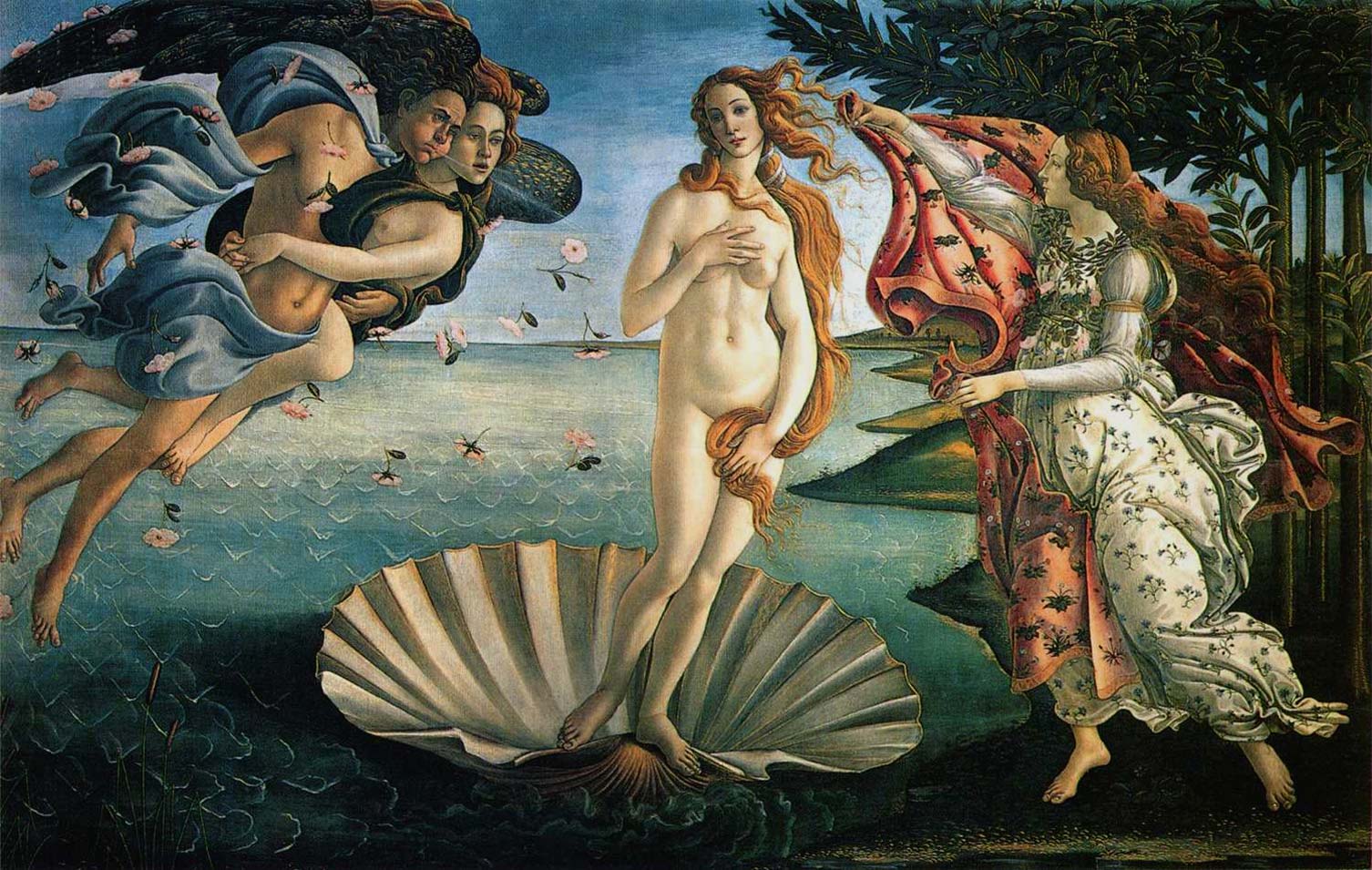
Naturally, there are positive and negative forms or deployments of production. The "good" and the "bad," as determined by our reason and perceptive senses. Hence, the poetic turn of phrase and the banal imprecation, the lovely song and the out-of-tune piano, Nabakov's Lolita and the propaganda warfare manual, the mythical cure for cancer and the wonder-weapon of biological warfare, and so on. It follows that classifications of good and bad depend on the perspective (Lolita as poetry or morally deprived rot (to, say, the cultural reactionary), the biological weapon as good for inventor bad for foe, etc.). And questions of scientific advancement depend on an idea of advancement. Progress is highly contested. Even art, whose pulchritude is the most clear-cut example of innocent production I can think of, is contested and controversial. It is a grab-bag, widely encompassing, and incapable of escaping its social and human influence. Therefore, Botticelli's "The Birth of Venus" can be seen as a symbolic masterwork or pornographic, anti-Christian mythology. The above examples serve to illustrate the inherent duality of things, which qualifies only as a digression in this tract. I press on.

Taking as given that production should be "good," without tackling the question of what is good and what is bad, I suggest that production should be. I mean, people should produce, and those with more brainpower, artistic talent, energy, or any other productive force (which can all be, to some extent, developed and honed during life), should produce more. This makes for a more beautiful, richer, more interesting and inspirational world and society to inhabit. Channeling potential energy into the kinetic energy of construction, formation, manipulation provides the stuff which enkindles the spirit. Art and functionality coupled engender enrichment and amelioration.

The second part of the puzzle has to do with need. Human beings have material needs for the avoidance of death. We also appear to have social needs, such as acceptance, flourishing interpersonal relationships - in short, to love and be loved - ego-based needs, such as self-esteem, and cognitive and creative needs - we need to stimulate that gray and white matter. We need to exercise these functions in order to be "complete" human beings - to sate physical requirements and retain self-awareness, ego, cognitive function, and aesthetic sensibility.

Needs imply consumption, but I argue that they are not fully comprehensible except in conjunction with production. Consumption occurs for the sake of production. Production is naught without the fuel of consumption. However, consumption for the sake of consumption is also gratifying. Food and drink are the most immediate and accessible example - they cause pleasure. Their gobbling and glugging represent a cornerstone of the Epicurean philosophy. In addition to being desirable and pleasurable in their own right, consumption of food and drink can be purposive - directed at production. They are literally fuel and produce the energy from which all action is dependent. They can be shared, they lead to merrymaking, they are necessary. As in all things, moderation is counseled, and minimizing consumption while optimizing energy and happiness outcomes is ideal. The hedonic treadmill illustrates the point. The principle of the hedonic treadmill is that, despite increased consumption, greater happiness is not usually achieved, because, among other things, rising and mutating expectations and desires raise the stakes ever higher. Happiness has surprisingly little to do with the amount of consumption, though there is obviously a lower bound below which squalor implies such deficiency that needs are not met and happiness is elusive. I propose the principle that minimizing consumption of all things while maximizing production is the optimal model for human life.

Minimizing consumption while maximizing production is a lot like "producing more with less." Productivity is key, but so is a sense of justice, need (as opposed to want), and a recognition of the value of production. Justice implies sharing the communal endowment, giving recognition where it is due, repaying debts and dues, while valuing production means recognizing that it constructs and determines our world. A person whose consumption outweigh's their production is a leech on the productive capacity of the planet and the output of others. He or she or it whose production supersedes their consumption has a net positive effect on the world - makes it more gorgeous, more interesting, more pleasing. It seems unlikely that the exchange of consumption and production is one to one. Which makes the enterprise of comparing production and consumption vectors dubious. It is obvious, however, that more production of "good" or positive ideas, artwork, constructions, and actions, results in a more variegated planet, and that we are the communal benefactors of that production. Many productions are, in economic terms, non-rival and non-excludable, meaning it is difficult to obviate the addition of consumers, and the cost of adding an additional consumer is close to zero. Goods which are like this include murals, bridges and dams and other infrastructure, public benefits of education, music and architecture and artistic flourishes to functional constructions, books and libraries, parks, etc. In this way, a person or a small group can produce something whose benefits permeate, unbounded. The rule of thumb: Produce more, consume less.

To put it into perspective, I subject myself to the magnifying glass: What do I produce and consume? For one, I have been undeniably and continuously dependent on my parents my entire life. They satisfy my material needs, whose satisfaction has allowed me to pursue creative, intellectual, and leisurely pursuits of all stripes. They foot the bill, they nurture, they voluntarily enslave themselves to my whims. What do I give back? My progenitors certainly reap some amount of satisfaction from having produced and raised me (Indeed, I am quite stupendous). That was their goal; that it is and has come to fruition in multifarious ways must be a source of great joy and wonder for them. Not only that, but I remain close to them. I am their friend. I love them. The bond between us is mutually or communally produced. The social unit made up of people is one of self-evident interdependence, whose purpose is to satisfy all members and contributers. This unit is part of a self-sustaining and repeating system. I produce the extant unit through belonging and playing my part, and further down the line I am expected to perpetuate the social construct with my own family and offspring, and so on and so on. I consume food, drink, shelter, security of mind and body. I produce thoughts, my brain builds synapse bridges, I develop skills and objective-driven capabilities. I make art sometimes, or all the time, I influence those around me with my words and actions (as they, in turn, influence me). I prepare for the future. I am an investment; my parents and I, my friends, my teachers, and the society are investors in my human capital. I work and produce to pay dividends and repay them their dedication and contribution to my personal development. Work is production, and work has as many guises and purposes as can be formulated by the fecund imagination.

It would appear to be a shame if, with all of the tangible and intangible investments in me, I turned out to be a wastrel, a rogue, or a self-absorbed, thankless jerk, refusing to take responsibility for all that has been given (produced for) me. I am modest about what a good life is, but there are many iterations of a bad life, many of which can be characterized by an improper or unhealthy consumption to production ratio. Consider the layabout, the highly capable welfare recipient, the larcenist, the Paris Hilton, the destructor. A life leaning immoderately towards consumption might appear to be desirable, but it is lacks fulfillment. It does not stimulate the social, creative, and cognitive - the productive - areas of our being.

Happy New Years!
Resolution 1: Produce more, consume less

Tuesday, August 18, 2009

Slinky

All Hail Concordia.
Observed physical "reality" proves naught,
That seen is tainted by that sought.
Induction is flawed unless borne from infinite,
No law is inviolate.
Polonius said, "Brevity is the soul of wit."
Every thing has an opposite.
Art is a distraction, science an oversimplification, and religion a put-on,
Truth belongs to all and none.
No thing has an equivalant.
Brad said, "Verbosity is the corpus of the fool."
Every decree is subject to defiance,
Deduction is imperfect without omniscience.
That sought is predicated on that seen,
Nonobserved metaphysical "reality" disproves the vision of the retina screen.
All Hail Discordia.

Tuesday, July 21, 2009

Coming and going and gadabouting

Since my formative years, I have attested to a strong desire to travel. My minor obsession was sown by my parents, who brought me from Florida to British Colombia before a dozen years had graced my blond brow. As my mane browned, my world-wise parents devoted spare time and money to my international, itinerant education. My lessons were taught by the coral of Bora Bora, the croisant of Paris, the Volkswagons of Taxco, the black waters of Istanbul, the harbor of Bergen, the slums of San Jose, the neons of Las Vegas, and the sausages of Austria. Abroad, I was a freewheeling sponge. I obediently dedicated myself to my obligations: observe and enjoy.

Between Canada with the gramps and my most recent international flight, 22 countries have borne my heavy feet for a significant period of time. Now I return from six months abroad in Cuenca, Ecuador and Santiago, Chile. The inhabitants of those lands amiably demanded the development of bilingualism, which I delivered. Their societies, people, and institutions and I interacted. We changed each other, but they changed me more, by virtue of more mass. I tried to resist, but alteration is inevitable. I capitulated. I had no other choice! But I maintained my suspicion, skepticism, and interrogative nature. I refused to believe anything which I could better disbelieve. Knowing I could know nothing, I tried to analyze things objectively. HAH! I learned that all observation is theory laden. All is sucked into a philosophical vortex of past experience.

So what do years of travel, purported travel love, and modern migrations produce. A kind of human universalism which is founded on principles of fundamental human similarity and subsequent, life-formed, and superficial cultural difference. Anthony Burgess affirms my belief, " Fundamentally people are all the same, and I've lived among enough different races long enough to be dogmatic about this."

I continue to express some other thoughts: no two things are the same, all things are connected, cause and effect is impregnable, and purity is non-existent. At least, these are some of my basic beliefs, based on my 21 years and my perusal of the accumulation of recorded human experience. They do not well-match any thought-system that I am aware of, but rather represent bits from here and there; from the forms and figures of my life. My philosophy is a whole, composed by innumerable influences, ideas, and impressions.
A character in a Janwillem van de Wetering - one of my many i's - novel called The Japanese Corpse presents the position eloquently: "What would I be? A good question. I have no answer. My mind is clouded by the countless thoughts with which I have identified myself and which have all left their traces."

It appears to me that delineated doctrines and ideologies are limiting and unrealistic. They are symbolic, theoretical, imperfect. And, we are equally imperfect, in our roles as adherents, constructors, channelers, etc. Ideology serves a purpose, but works best when paired with aggressive skepticism and liberal democracy; freedom to share, evaluate, and choose, in the absence of imposing thought-crushing power, represents the best outcome in the philosophical and moral realm. We should combine human and personal experience to settle on personal belief: what is and what should be: the structures of science and metaphysics: our understanding of the world and its features.

In a future writing, I will explore whether or not some personal thought-systems should be considered to be better or more desirable than others, and what that should mean for the actions of individuals. For now, I go full circle in order leave this digressive article where it began: travel.

Travel, according to my aforementioned propositions, is (in part) an expedition for observation of human cultural differences. It is an expansion of experience, hence an expansion of the foundation from which we make belief choices. It is risky and radical, involving new bumper car contexts of cause and effect, influence and mutation. New friends and figures and institutions and forces, channeled through our theory-laden viewfinders, distort that which we know and impulse change. With the great human power of personal sovereignty, we decide to change positively or negatively - evolve or devolve. And, of course, change is inevitable...

Sunday, June 21, 2009

No archipelago

I was invited to ponder the influence of a certain period of life on my life. I admit that I struggled somewhat in responding. My answer portrayed every act, incident, thought, etc. as a separate island in an archipelago of events. Furthering the geographical metaphor, we would propose that the girth and depth of each landmass represents its influence, its power. Although appealing, this is a spurious conceptualization. Why?

This is important: Everything is connected. Everything. Acts are not islands, nor are humans*. I have found metaphors to be misleading; no simple pictorial, verbal, or quantifiable function is capable of describing the interconnectedness. A continuous function is approximate, but visual Euclidean geometry unsatisfactory. O, the interminable dimensions! Life is an ocean of intermingled particles and organisms, all mixing, twirling, crashing, seeking to control by personal propulsion, but subject to the omnipotent tide and current. Humans ebb and flow with the rest.

Personal development is continuous. It is progressive and digressive. An influential incident, pattern, or period of life on life causes notable progression or retrogression. Change is inevitable; (reverting to the Euclidean plane example) no human being is a constant function. It is also typically gradual. There are, however, principle periods of flux, the most obviously accelerated one being youth (generally portrayed as developmental). This is the time when we process personal experience into personal knowledge. To the very young, everything is surprising. As we age, we ossify; we choose and invest and define ourselves, we settle into a comfortable reality. We come to know the world or we come to think that we know the world or we come to accept a certain interpretation of the world (Clearly, for this exposition, knowledge = belief). Surprise to common phenomena fades. Only the radical manifestations of nature (including human nature) surprise us.

Surprise is a function of ignorance and close-mindedness. The world as it is is ours and it is comprehensible. Unnatural is a misnomer. Unnatural does not exist. Unnatural is a societal allegation. All that occurs and is capable of occurring is natural; it belongs to our world. What else could it be?

Personal progression, for me, is the development of comprehension of the one world and, necessarily, the position, purpose, and nature of one's self in the world. This is a step beyond the above-proposed accumulation of knowledge/belief. It is the development of what is often called wisdom: Precise knowledge and keen discernment of what is and what "what is" means to oneself and the human species. It is that which leads us to a wise state of being which is personally and progressively influential.

*Remember John Dunne: No man is an island, entire of itself... Any man's death diminishes me, because I am involved in mankind and therefore never send to know for whom the bell tolls, it tolls for thee.

Wednesday, May 06, 2009

Non-sense

I was perusing recently an impertinent and thoroughly engaging text called, On Bullshit, by the Princeton professor emeritus of philosophy, Harry Frankfurt, when I stumbled upon an inspiratory detail: Non-sense. This precious construction was noted as the arch-nemesis of one of the monumental philosophers of the 20th century, Ludwig Wittgenstein.

As you, friend-follower, have undoubtedly noticed, I have a penchant for criticizing the human proclivity for illogic. As I have pontificated prior, we are feeble, defective creatures, with curiously disruptive effects known as emotions. Said overly-simply, reason, logic, and scientific representation of reality were the heroes and obsessions of Mr. Wittgenstein. They are also friends of mine.

Either way, I now have a prominent citation from which to defend my arbitrary outpourings on the theme of illogic (or non-sense). Perhaps Wittgenstein's word outplays my own modest term (which I picked up from Christopher Moore) when it comes to precision. Nevertheless, I do not and never have promised to be profoundly honest, realistic, or scientific in my writings.

What? Say you that this is contradictory with my past and pending statements on the all-importance of reasonable thought and the insidious character of illogic? Nay, I say to you. I turn now to Harry Frankfurt and distance myself from L. Wittgenstein. I promise to bullshit you, sir or madam, when I see fit, in the pursuit of perspicuous thoughts or witty turn of phrase (well, according to me).

This does not negate the possibility of scientific analysis or the promotion of brutal logic, nor does it mean that I am lying to you. I will not deliberately, in fact, attempt to misrepresent my thoughts and beliefs, the contents of my brain. I will strive to entertain you and myself with a diversity of writings and scribblings that will include plenty of bullshit, art, pseudoscience, and invention.

Really, I am planting a devious honesty, professing to use an artistic license, and claiming fidelity to the use of a Borgesian approach to keeping your attention (What can I hold you with?). If my method works well, and you examine my words with microscopic care, maybe you will even learn something real about me.

Monday, December 29, 2008

Eep, eep, where are the modern science fiction authors at?

I shudder to think of the path that society is taking. I shudder not out of fear, exactly, for fear is mostly useless, but out of anticipation and curiosity. Yeah. Where are we heading? It seems as if the physical-consumer world is disappearing. Everything is becoming e-commercialized. Purveyors of physical music - CDs and records - are noiselessly falling by the wayside. Booksellers are following suit. Before that, we saw the incremental elimination of the Mom and Pops, the little guys, the stores with care and character. And, of course, the larger-than-life economic recession is not helping the situation.

I take the position that this is stuff we should be concerned about. I simply dislike the one-stop-shopping model, the humongous, impersonal, hideous factory-stores, the mass-produced, unwholesome food, the uniforms, the slogans, the sham, the glitz, and the kitsch. It is blatant and undesirable homogenization and insipidization. It is depressing.

Of course, there is a flip-side. There is always a flip-side. We must recognize that current capitalist processes are making life cheaper and, indeed, better for many if not most people. Stuff is cheap, decent, and outrageously accessible. The Walton model works wonders.

Then again, this throws a lot of uncompetitive retailers and manufacturers out of business. Simply put, they cannot compete with the monster-scale of super-corporations. Small stores' prices are higher, and so they lose.

Of course, poverty, exploitation, and social calamity are all the more egregious and hideous overseas. But...those people are poor. They are "underprivileged." Too bad. We get the cheap goods and, many previously poorer people abroad now earn an income, however meager. We love the $2-tee shirts, the mangoes in December, the dirt-cheap televisions, eye-glasses, DVD players, drugs, automobiles. The price per value ratio for stuff today is truly miraculous. Everyone has a big-screen TVs and uber-cable. The commercials impress themselves painfully on our eardrums, the glare is blinding.

If we want change, it is up to us, the informed and willful consumers. We own our current predicament. We do not have the prescience to recognize cause and effect or the discipline to stop ourselves. Some of us care enough to boycott what we see to be the biggest, meanest retailers.

But even beyond that, may the Earth-mother continue to smile upon us, some of us are ABLE to boycott the big, bad corporate bullies. Yes, yes, it is nice not to have to depend on Walmart's generous social services, bargain-buy drugs, diapers, and TV-dinners.

It is necessary to recognize corporate irresponsibility, and capitalistic excess, but equally important to note consumer preponderance. We pertain to coercive systems, sure, but ultimately we design those systems.

I just wonder, where we are going? What will this world look like in 15, 20, 30 years? We need to examine the science-fiction and dystopian-novel gospels. Maybe we need some prophets. I have ambiguous tremulousness thinking about mankind's future. It is quite exciting, no?

Sunday, November 23, 2008

Sunday reflections

I woke up this morning exuding serenity and moved my living corpse to the bathroom for my diurnal pee. Once there, I positioned myself, leaned my head against the cabinet, and lost myself in my own reflection in the toilet bowl...

Who here has read "Narcissus and Goldmund?" Hesse is the master of the pensive epic, and this but one of his philosophical works. It contrasts spiritualism and hedonism; fixation on mind and body. Ultimately, enlightenment is personal, but mixture is advisable...

Sugar, flour, (a lot of) butter, chocolate chips. Oven. Stove top for cooling. Amorphous mass of deliciousness. Bradley likes blondies! (and brownies, for that matter, but they require variation in ingredients)...

Daddy. Mommy. Genetic components combine. Progeny. Simple, but then immediately complicated...

Touch your baby as much as possible; make sure there is time enough for love. Teach it, protect it, nurture it, do not stifle it with stricture. The rest is up to the world...

Find friends that are smarter than you. They will teach you to be as bright as they are...

How many environmentalists does it take to screw out a light bulb. One, if he/she is wisely equipped...

Do not break bulbs, "borrow" them from those that use them immoderately. There is too much unnatural illumination...

Waste not, want not...

Blessed be the poor and cursed be the rich was never practical. Recognize your good fortune always, and make honest and selfish decisions accordingly...

Sure, it is cold, but is not the snow beautiful!? You must always give some to get some, just ask Newton...

The Fig Newton is a polarizing cookie. As is the Macaroon. I like them both for their merit, innovation, and tastiness...

Go to the abode of Allie Jennings if you want the most titillating treats around...

Thank humanity or luck or your g(G)od or ghost or anonymous benefactor for all of the good that is around you...