Showing posts with label Culture. Show all posts

Thursday, August 18, 2016

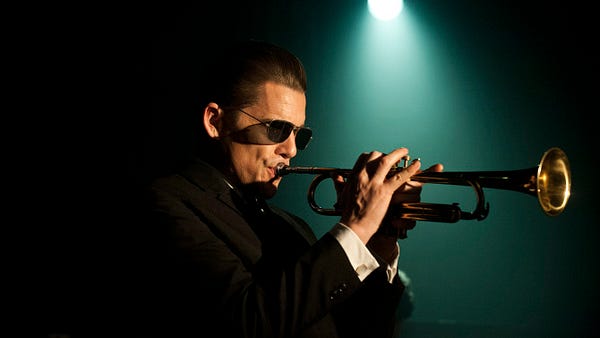
Ethan Hawke on life, work & "Born to Be Blue"

I was sitting in the dark at Nitehawk cinema in Williamsburg, Brooklyn. The film had ended. And Ethan Hawke was dropping wisdom.

I had just watched Hawke portray hunky, junkie jazz trumpeter and singer Chet Baker in biopic Born to Be Blue. The film had left me in limbo: I didn’t know what to think or how to judge. I felt conflicting emotions. Into this, stepped Brooklyn resident Hawke to talk about the movie, Chet Baker, and his own life.

Born to Be Blue plays like one of the wispy, wistful Chet Baker’s tunes that Hawke whisper-sings on screen. Chet sings about love and about not-love. He sings “Let’s defrost in a romantic mist, let’s get crossed off everybody’s list…Let’s get lost.” He sings “My Favorite Valentine” to his girlfriend, Jane Azuka (Carmen Ejogo) who he seduces from the set of a biopic in the biopic where he plays himself and she plays “The Women of Chet.” At first she can’t understand those women, then she can’t not become them. Chet has the stuff of legends, but he’s fragile, wasted, like a sparrow with a broken wing. The film shows how Baker, and those irresistibly drawn to him, try to mend his wing so he might fly again.

On the Nitehawk stage, Ethan Hawke talks like some of his famous characters. He speaks the imaginative blue streak of Jesse in the Before series and with the insight and sincerity of Mason Sr., the dad in Boyhood.

He says you should watch the film (yes, you should!) as if you’re listening to jazz: “There’s this amazing thing that happens when you listen to Chet’s music. And a lot of great jazz. It just takes your brain somewhere else. The movie should be like if you laid in your room and closed your eyes and just listened to three Chet Baker LPs in a row, what would come to mind?”

Like Chet Baker, Hawke kicked off his career young. He rose to acclaim playing the shy student in Dead Poets Society in his late teens. After that apex, he said, “You see absolutely nowhere to go. You just think that’s the normal temperature. I’m going to do a movie and it’s going to be great and everybody in the world is going to love it and everybody is going to say wonderful things about me and I’m going to actually work with wonderful, really talented people who really care about me and make lots of friends. This is a great life! Well, it’s never happened again!”

Baker got his big break from Charlie Parker, whose trumpet solos Baker played back to him at an audition. Parker invited Baker on the road. Baker soon cribbed the Bird’s heroin habit too.

Hawke talks to the challenge of staying straight and true in the spotlight. “[Chet] goes on the tour with Charlie Parker, he’s meeting everyone. And that was the key to the kingdom. Then what do you do once you’re there? How do you not turn into a rotten prince? It’s very hard. You have to actually be a substantive human being. And that is a tremendous amount of work, that most of us are not up for.”

When he talks about drugs, Hawke commends the film for resisting the urge to “finger wag” and says, “While we can all agree that drugs hurt people and poison our own roots, a lot of really good people do them." He mentions the late Philip Seymour Hoffman. "To ignore why they might choose such a path is to ignore a giant truth and to sell young people a lie. The lie isn’t that drugs are bad. They are really destructive. But if you don’t really look at why, what insecurities are driving it, then you don’t understand why somebody smart would do it.”

Few of us know what it’s like to attain princely acclaim at any age. But many can relate to feeling an inconsistency between how the world sees us and we see ourselves. Maybe we feel false for receiving external acclaim but feeling impoverished inside. Maybe we feel convinced of our own special talents, but overlooked by the world. Hawke suggests that winning and losing the fame game are often as close as adjacent cards in a deck. Each is fraught with its own perils.

Hawke advises us not to use the lottery of life to inform our values and self-worth: “There’s no rhyme or reason all the time. And so things like integrity and grace have to be their own reward. The world doesn’t applaud you for that. The world often applauds some of the most vile behavior. And that’s mysterious.” Instead, he suggests that we find value in ourselves: “Each one of us is imbued with something beautiful and unique to ourselves. For lack of a better word that’s our talent. You can piss on it, shit on it, or treat it with respect. It’s still there. It’s this thing. It’s you. It’s me. It’s who we are. It’s the essence of us.”

Saturday, December 27, 2014

Resolution: write

My New Year's resolution is to write more or rather to write. Here are a few ideas that have been floating around my head or just in this moment came to me:

Icelandic arcs: A story about Iceland and its people; the financial crisis; tourism boom; and society's shifting landscape. I'd approach these ambitious topics through a profile of Hadda and Haurkur, who own and operate Hrifunes Guesthouse and Iceland Photo Tours. I stayed with H&H at their guesthouse in November. I want to explore the tension between hard work and gambling: how H&H worked to build things, and in contrast how hot shot bankers profiteered from gambles that eventually landed the 300,000 Icelanders with billions in debt. The premise is that individuals, including those that head up institutions (i.e. banks, governments) operate by principles. Haurkur and Hadda reflect good principles; many bankers reflect bad ones. Most clearly, the latter ended up living large on borrowed money and dropping their debts on the likes of Haurkur and Hadda. However, now H&H are thriving on the unexpected result of the speculative investing: the weaker krone has precipitated a tourism boom that is reshaping Iceland's many contours.

Dying migrations: A ruminative encyclopedia of migration with a focus on extinct, perishing, hampered, and mutated migrations (are there any?). The unit of analysis here is the migration itself, the periodic, ritual journey of procreation and renewal. I'd build up from the journeyers to the journey, synthesize across journeys, and then delve into dying migrations. I'd interrogate first, what is the purpose migrations? Who journeys and why? What is the salmon's motive, the goose's, the whale's, the antelope's? Are there human migrations? Why? I'd close with philosophical thoughts, untethered to great thinkers, on the loss and mutability of things. 

Dormant connections. In the mid- to late-1900s, the University of Pennsylvania partnered with a technical university in Shiraz, Iran called Pahlavi University, since renamed Shiraz. Penn worked extensively with Pahlavi to redesign the university in the American model. Students and teachers shuttled back and forth. Professors collaborated. Pahlavi awarded President of Penn, Gayord Harnwell, an honorary degree for his work. Then the Islamic Revolution happened, ended the collaboration, dug a nigh-uncrossed chasm between the universities and the countries. I'd like to explore the dormant connections and the potential for reconciliation in the political dynamics. I don't want to harken back to a better era. The earlier intercourse rested on imperial, autocratic, and unequal foundations. The Penn-Iran connection betrays a similar inequality of flow, an unevenness, elements of paternalism and imperialism. It was beautiful but it was imperfect and perhaps it fed the discontent that drove the revolution. Nonetheless, I'd like tot talk about the relationship, current political events, and prospects for reviving the lost relationship between Shiraz and Penn and Iran and the US.

Thursday, January 26, 2012

Rant of an ulkomaalainen (foreigner)

Brad: What am I up to tonight? Well, I'm hitting the Finnish again...

Brad: You're what!? What tomfoolery is this!? Why play Sisyphus?

Brad:
My dear one, you can and should be a Debbie Downer if you want to be--you have logic, the majority opinion, and inertia on your side. And me? Behind me are assembled 5.4 million snowpeople (including Santa Clause, trolls, and various humanoids), some 200,000 reindeer, and 187,888 lakes. But, alas, I am not equipped with rejoinders. I shelter behind the vintaged commandments: respect people and country, avail oneself of the uniqueness, when in Roma and whatnot.

Brad: Kind sir, I see. Perfectly reasonable! I respect your respect for the Finns. Those sweaty nudists, reveling in the phantasmagoria of the northern lights, drinking the drink, and skiing the freaky fluke of Europe. Why not go native?

Brad: Assuredly, yes, a staid people with eccentric habits. I'm keen to join the club, but even they discourage learning their hairy tongue.

Brad: Haha, hairy?

Brad: Dotted, you know, not bald, but covered by a spotty turf, a prickly rug. For instance, "Miten täällä on yht'äkkiä näin vitun suuri määrä ihmisiä?" The question is this: Am I, AbelarBrad, bold enough to hug the bizarre to the bosom, to subject myself to an obscure and thankless toil? What kind of insane person wouldn't? Balls to sanity, normality, nationalism, conformity, pragmatic or instrumental logic, cost-benefit analysis, inference-to-the-best-explanation, optimization, conventional wisdom, the profit motive. Balls to the whole kit and kaboodle. Balls to Mitt Romney. I'm taking lines from the illogicians. Now is the time to suck the shock elements up the nostrils to discordianize the chains of command in the brain, the 'mind-forg'd manacles' that Blake wrote about. A friend I met this weekend said it best, "Hay que aprovechar chingada mierda, hay que aprovechar" (OK, I added the green language). Cachai? Moreover, what's a greater despoil of time: to dedicate oneself to a moribund language without hope of using it let alone becoming its master, or, given just one chance in a lifetime, failing to affix the lips to the cultural fire hose? And what is culture anyway? Bingo!, you guessed it, it starts with "lang" and ends with "uage"! It's not enough to ski and sauna to my heart's content, I need the langue and parole, I need Finnish.
So that's my rant for the day.

Brad: All hail the sultan of Finnophilia, ye squanderer of resources, cultural omnivore, engrossed in the fallacy of the unbounded, cosmopole lost in orbit. Get a real job, you eternally adolescent hipster day-tripper, you millenial, and then come talk to me--in English, if you please, the language of the ungraspable past devouring the future, the language of the always.

Wednesday, September 29, 2010

Reflections: Chauncy's "Gay New York"

There is but one required class in the 1-year Master of Arts Program in the Social Sciences (MAPSS) at UChicago. Namely, "Perspectives in Social Sciences Analysis." "Perspectives" intends to survey the nine different approaches - NOT disciplines - of the social sciences. These discipline-spanning perspectives have distinctive theoretical features, analogies, pioneers and lineages, and the like. They include historical narrative, rational choice, Marxism, structural functionalism, etc. By presenting this lay of the land, the program indoctrinates us with its particular, highly Chicagoan, meta-method and meta-perspective. More on this later.

For now, I want to comment on some features of one of the course readings: the first two chapters of George Chauncey's Gay New York: Gender, Urban Culture, and the Making of the Gay Male World 1890-1940 (1995).

Chauncey's premise is disarmingly simple: contrary to popular belief, male gay culture was not only visible during the period of survey, it was conspicuous. As far as this is the argument of the book, it is easily corroborated. Chauncey draws from multifarious and reliable sources to make his case and follows each chapter with a list of annotated sources indicating the nature and origin of the evidence. Allowing that all truth is subjective, embedded, and imperfect, Chauncey's historical narrative seems to be as capable of approaching truth or verisimilitude (truthlikeness) as well as any other method. Which I guess is my endorsement of historical narrative, albeit superlative historical narrative.

Chauncey begins his book with the visible culture of gay New York at the turn of the century. He hastens to add, however, that this was only the tip of the iceberg, the flamboyant and bold vanguard of revolution. Indeed the queerdom of underground New York was a verdant landscape featuring exhibitionists and those that more substantially valued their privacy. Interestingly, he makes the claim that "the closet" was somewhere gays were not.

Naturally, there is a lot of complexity to this metropolitan network. Class, ethnicity, and geography cleave powerfully through it. Gays are described categorically as "perverts" and "degenerates" by media outlets and mentally branded as such by the status quo. The Bowery bunch (the Bowery wasn't the limit, just the locus, of flamboyant nightclub and saloon activity) adopted, appropriated, and fashioned a complex "fairy" identity grounded largely in "effeminate" or "feminesque" "semiotics (or system of identifying signs)."

Chauncey writes, "they [Gay men] undertook artificial means to cultivate the shape, density, carriage, and texture of their bodies" (p.54). They also adopted important sartorial markers, such as red neckties, garish colors, flair, and cosmetics. It is worth noting that all of these symbolic and stereotypical signs were mutable - Chauncey writes about "the extraordinary plasticity of gender assignment" (p. 56). All in all, the sum of overt gay male differentiation amounts to identity formation of an "intermediate sex" type. For this reason, gay men were often called "inverts." This identity formation was itself composed of stereotypes which were used, for different purposes, by both gay males and their antagonists.

It is worth noting that gay appropriations came from feminine forms and norms, but not just the forms and norms of any feminine. The "fairies" adopted the dress, attitude, and actions of prostitutes and "tough women." Unconventional women. Overtly sexual women. Go-getters, risk takers, lovers. Like Mae West. Writes Chauncey: "The faries' style, then, was not so much an imitation of women as a group but a provocative exaggeration of the appearance and deameanor ascribed more specifically to prostitutes" (p. 61). As gay men assumed physical aspects of this identity, they molded a recognizable culture and oriented that culture geographically within working class districts of New York City. Chauncey makes the case that working class (white, obviously) social forces met the "fairy" phenomenon with modal ambivalence, although certainly not respect.

Of course, that still leaves room for more radical reactions. Gay men were targets of desire and violence. They were unambiguously marginal citizens, just like the prostitutes and "odd" tough women from whom they had appropriated so much of their identity (not to mention craft: much of the gay sex world - just like the heterosexual sex world - orbited around sex for hire). This meant that gay men were often objectified, brutalized, and robbed by more conventional men, gangs, and street youths some of whose homo-erotic habits might have been self-perceived as 'sporting' or 'releasing.' Gay men had little legal recourse because they were seen as "outlaws," who wouldn't want to bring official scrutiny to their "degeneracy."

Chauncey, however, sinks not into gloom over the inherently "contested" nature of gay New York. Instead his work is a revelry in the culture and collectivity of 50 years of gay life. His work is prominent for excavating and unpacking this doubly underground and obscured time period in gay history.  It is lovely to get lost in the rich detail of his narrative. Subsequent challenges to homosexuality would come in the 20th century.

"To use the modern idiom," Chauncey writes, "the state built a closet in the 1930s and forced gay people to hide in it."

I strongly suggest checking out Chauncey's book. Stay tuned: he will be releasing a volume two, covering 1940-the present, shortly.

Thursday, September 23, 2010

Niggardly feminism

Before anybody gets the wrong idea, niggardly, as defined by the free dictionary (my favorite dictionary), means 1. stingy and 2. meager. In this case, I'm talking about the tightfisted type.

Second, fear not the feminism. It's not only an unavoidable, ubiquitous social presence, it's more maligned and mischaracterized than it deserves to be. Shed your stereotypes and caricatures and take me on for size: an unabashed modern feminist - with a penis.

Instead of delivering a feminist manifesto, which would be asinine on account of this being a blog, not a book, I will examine one case which I think is relevant: dating etiquette and paying for meals and drinks.

Nobody would deny that it has long been socially normal for the man to play the aggressive role in the courtship process, and for the woman to play the complimentary passive role. In line with these general and relative roles, the man has long been the one to 'treat' the woman, especially to dinner or drinks. That is, the man is the predominant payer. This fits in to an old matrix of social norms based on a certain gendered social, professional, and familial roles. Although this matrix has been eroding and changing, its effects are still palpable.

One more point: the feminist analysis and prescription for change, like all other social prescriptions (e.g., civil rights, human rights), is explicitly idealistic. While such prescriptions can and should be grounded in positive observation of current conditions, they are guided by normative judgments and a vision of an ideal or improved social order. Feminisms seek a more optimal world by changing manifestations of gender roles. To believe in an idealistic feminism, one must believe that there are gender roles (everybody believes this) and concede that they are sub-optimally (unjustly) organized on inadequate or fallacious grounds (this is controversial).

So, to get to the case in question: Who takes out whom? Who pays for dinner? Who pays for drinks? Why? What are the implications of this?

The first question is prickly. Women can be quite as audacious as men. And indeed there my be little to no gender divergence on this question given the state of things, at least, in the northeast United States, people and relationships being as physically (sexually) motivated, as informal, and as promiscuous as they are. But I will dare to suggest that most women would prefer to be asked out while most men would prefer, or at least feel a social pressure, to ask out. I'll leave it at that.

The second two questions or, "Who pays?", have three possible answers: (1) chicks, (2) dudes, (3) they pay equally. Although some statistics would be nice at this point, I think we can safely assume that the answer is (2). This is not controversial. The controversial question is: should things be different?

Some people would say, "Who cares?" Even an avowed feminist friend of mine took this tack, with the time-honored "pick your battles" rationalization. Other people talk about biological determinants of historically entrenched gender roles - real and inherent physiological and purported psychological differences between men and women. I believe there is a kernel of truth to this argument, but that it is dangerously versatile. I've heard it deployed by progressive feminists and reactionary misogynists alike. In the case of dating etiquette, it has no traction. Another group of people talk about their personal experience and feelings, and whether or not they like or dislike playing into these roles. This is opaque ground. Often such slippery language obscures or replaces the exploration of more selfish, candid motivation.

Personally, I think the dude buyer paradigm is a quaint and anachronistic throwback. I think it's unjustified given the independence, education, and potential of modern women. It's an impediment to "progress," to a rationally organized social-romantic interaction, to - GASP! - greater equality.

This is where idealism enters. It's not that 'absolute equality' is a goal, or even plausible (parse this post for my view on the 'absolute' or 'pure'), it's just that we can do better. And I think that better, in this case, means acting according to reason - i.e., equivalent payment or proportional payment - instead of following the well-trod, gendered, and unexamined path of traditional patriarchy.

However, it would be unfair of me if I criticized other people's opinions - the alleged opaque ones - without examining myself under the microscope. Am I merely trying to get out of having to pay for stuff? Am I just a stingy cop-out short-cutting loafer schmuck? What is this niggardly feminism?

I reject that label. I swear I'm not ungenerous or tightfisted - even if I am a student of economics, with optimization and opportunity cost constantly on the brain; even if I am personally poor; even if my parents pay my bills (Thanks Mom and Dad!). No, I just think that there's something screwy when one gender with only marginally more economic success - inconsequential in certain (limited) circumstances - is the predominant payer. Women play into this when they actively tempt or passively accept drinks from moneyed men at bars, absent any interest or intention to further the relationship. This is not beating the system, it's floozies exploiting patsies.

Ain't nothing in this life that's free.

My major point is this: there's nothing wrong with treating your significant other or some sexy stranger to a drink, dinner, movie, or whatever. There is something wrong when it's a one-way street.

What the fuck should I make for dinner?

A friend turned me on to this site (click image) which is both hilarious and useful.

Tuesday, July 27, 2010

Tuesday reflections

Bluejays are beak-stuffing slobs, with dainty and sleek feathers, superficial cover for gluttony...

Bradleys are procrastinators, with hip-hairdos and polished noggin netherworlds, who whittle away hours twiddling internet ding dongs and doodling narcissism...

Squirrels are depraved backyard denizens, violators of all seven deadly sins, rapacious and cunning delinquents, munchers, camouflaged monsters, objects of detestation...

"Hello morning!" is betoken by 7am wake up, followed tenaciously, alarms like calls to prayer...

My hope is for luminous mornings, indefatigable days, reading evenings, and - o gosh, finally - stable habits, and reliable relationships...

Libby (canis lupis familiaris) is as omnivorous as a goat - she scarfs a morning walnut ritualistically; grapes are delicacies; chicken bones can be procured through trashcan larceny; and the evening meal is human fare - certainly a princess among beasts...

What is one to make of Pynchon, the 'postmodern' luminary? G's Rainbow is a ponderous epic, singular and difficult. Is there some concealed genius - an ironclad kernel - is he just a clever scribomaniac?
The Mars Volta would seem to follow logically, part of the frantic dialectic which cherishes beautiful discord...

Syracuse, NY, most magical at nocturnal hours/ urban air after gloaming/ from illuminated city to atmospheric gloom/ and in between, ladders of light like celestial towers...

Tuesday, March 16, 2010

Mind body dialectic

To maintain a physical body in 'good shape,' I believe that it takes as little as 6-10 hours per week. A more modest estimate - or a more relaxed definition of good shape - might result in a smaller lower bound of, say, 4-8 hours. For our purposes, good shape implies moderately high levels of athleticism, physical health, and success in some sport-like endeavor. Naturally, I do not mean to be overly rigorous or exclusive here: a person who does zero targeted exercise (and, instead, lives an active regularity), can be both healthy and relatively athletic. But, I am referring to developed muscle and endurance, and honed athletic prowess. I will self-indulgently assume that I have all these characteristics in order to use myself as experimental subject:

I have come to conclusion range after observing my own weekly exercise formula. My range for targeted exercise is, on average, between 4 and 10 hours per week. The disparity between minimum and maximum hours is indicative of my mercurial schedule and way of life: I have no typical weekly exercise regimen, only regular activities: running, rock climbing, lifting weights, jumping rope, and stretching. I also have irregular activities: hiking, kayaking, skiing.

This week (Sunday March 14 - Saturday March 20) is characterized by consecutive days of rock climbing and running. I run for about one hour every other day and climb for about two hours every other day, resulting in an alternating sequence. With the aim of engaging in full-body workouts as much as possible, I always combine auxiliary kinds of exercises (e.g. stretching, push-ups, sit-ups, jump roping)with the primary activity. For instance, today I ran 4 miles in the succulent sunshine and also jumped rope, did pull-ups, and stretched. This week, my allotment of time to exercise is some 9 hours.

The argument that physical good shape exists and is something one achieve's through laborious and strenuous exercise is essentially intuitive and not controversial. My range of hours is both wide and relatively modest, and should, I think, be highly acceptable.

I follow this inductive, intuitive argument up with a question, whose answer is not as obvious:

How many hours must one dedicate to targeted cognitive exercise in order to be in good shape mentally?

Tuesday, January 19, 2010

Are people fucking with me?

Seriously. Since posting on the paranoia, I have experienced some strange encounters, which have not allayed my fears. If anything, they have vindicated the age-old sensational craziness; my monomania is flourishing.

When seeking to pass from Redfield Pl. to Walnut Av. in Syracuse, a point-to-point itinerary I pursue regularly, and given the inability to soar through empyrean spaces, one must navigate through or around Thorden Park. Conventional wisdom is firmly of the opinion that perambulation through the Thorden is folly. There are many discreet historical reasons for avoiding the place, especially at night. Alice Sebold, author of The Lovely Bones was raped there. She immortalized her rape and recovery and the eventual conviction and arrest of her rapist in the memoir, Lucky. The title comes from the ever-clever Syracuse police, whoe purportedly claimed that she was lucky, because she was alive; another woman had been brutally murdered in the same spot, years earlier. In addition, a well-loved graduate student, Alec Waggoner, was tragically killed on Thornden Park Ave. in October 2008, very late at night, after colliding with an SUV on his bike. Naturally, these occurrences should induce prohibitive fear into all but the blithe cretin. Nevertheless, there appears to be something wrong with my reckoning ability: I regularly pass through Thorden, at all hours of the day and night, on foot and bike. Yes, I do.

Two days ago, I was meandering meaningfully down Greenwood Pl., less than a block from the edge of the park, when some ragtag youths in a parked jalopy implored me to come to the window of their automobile. They waved and turned up the edges of their mouths, as if to smile, not jovially, but with an unctuous urgency. I was actually running, but that minute sort of walking, as I had been just moments before swinging my apelike arms in concentric circles, and perhaps doing high knees. My new iPod Touch was grasped in my ham hand, and noise-emanating ear-buds plugged my upper orifices. First, I turned around 180 degress to glance at five individuals playing some esoteric kind of handball. They appeared to be deeply focused, and clearly not sending or receiving gestured messages. I wasn't really in the mood for a chat, and wanted to get back to running, so I politely rejected the invitation with a firm double shake of the head. They gesticulated, I shook again, and kept walking. It could have ended there. In fact, it could have ended before it even began. I mean, this sequence of events - recorded herein with as much accuracy as my musty brain can muster - did occur. That which follows is of less tangible stuff. I admit to being slightly shaken by these happenings, and as I converted my walk into a trot and then into a brisk jog, I looked back a couple of times over my shoulder to survey the site of the skirmish. Two of the four gentleman stepped out of the car. Whether or not they looked at me is still an open question. But they might have looked - nay, stared - and there might have been lambent licks of malice and intended harm in their eyeballs. Who knows. I continued to jog, my placidity marginally perturbed, and my adrenaline pumping a little higher than it usually does when I exercise. If you know the geography, you know that Greenwood intersects with Thorden Park Dr., which swoops down and into Beech St. Following Beech, one comes to Madison St., which then goes towards and eventually hits Walnut, precisely at the block I wanted to be on. There is a byway, also Thorden Park Dr., through Thorden, which comes one way the opposite direction I was traveling, from the corner of Madison and Ostrum Av. I took Thorden Park Dr. the wrong way, towards Madison and Ostrum, but as I cruised, senses honed and neurons firing red alerts, I saw (or thought I saw) the jalopy (which was green, incidentally) heading down Beech towards Madison and my destination. At this point, I did something unexpected. To avoid a second confrontation with the thugs, I abandoned the roadway altogether and sprinted through an obscure path, overhung by coniferous giants, in Thorden. This sacred glade, of rectangular shape, sits between Beech, Madison, Thorden Park Dr., and Ostrum. Upon reaching the other side, I had apparently shaken the amateurish stalkers and obviated ambush. This was the first event which reinforced my paranoia, but because it is so shaky and built on unsubstantiated conjecture and borderline irrationality, I decided to tell no one.

The next day - today, January 19, 2009 - any misconception I had ever had about the illegitimacy of my paranoid mania dissipated. Again, I was making the same voyage, from Red to Wall. This time, however, perhaps subconsciously to protect myself from footed rabble, I was flying on tires. The purple Rockhopper--my bike--carries my swiftly and surely, with nothing short of heroic devotion. I was cruising passively and happily through Thorden, admiring the naked branches and sullied snow banks, after a day of silly rain. Of course, a vestige of the prior day's perturbation remained, and I was unusually vigilant. My paranoia hovered like a man-moth but it calibrated my sense-perception. I am rather glad it was there, really. You see, I was rolling along, listening to Carlinhos Brown ("O aroma da vida"), and I was again going the wrong way on Thorden Park Dr.--like Alec, but on a straight, highly visible part of the road, and during the day--and I was about 100 yards from the terminus of the road, where it connected with Madison and Ostrum. All of a sudden, a gray or beige station wagon of unknown make and model, entered my roadway, and started coming towards me, with surprising rapidity, in clear contravention of the posted speed limit. Instead of staying to his or her side of the road (their right side), the psychopath at the wheel evinced a strange predilection for the left side of the street. I swear, the maniac, gaining in velocity all the time, was actually rubbing the curb - my curb - where I was also residing, moving forward on my purple stallion, anxiety building. The game of chicken appeared to me to be unfair, so I capitulated. Braking, I leaped off the bicycle, luckily directly behind a metal light-post, and threw up my arms in offended consternation. What nerve! What homicidal douchebaggery! Heinous fuckery most foul.

People are clearly fucking with me.

I need to be on top of a mountain where I can see everything, 'cause this paranoia is getting old. - Shannon Hoon/Blind Melon (RIP), "Walk".

Friday, September 25, 2009

Gone on (economic) growth

Nobel prize-winning economists, Joseph Stiglitz and Amartya Sen are rejecting the notion that GDP growth is THE index for measuring economic and social well-being. They posit that perhaps we have lost perspective; in the quest for growth maximization, other valued objectives have become obscured. One thing is sure: the growth game is hegemonic. It is also adversarial and limited. It makes one think of body-height eating-capacity competitions.

Clearly, the tallest or largest person is not necessarily the healthiest or happiest (indeed, gigantism is a sad, crippling disorder - just ask André the Giant). Likewise, those that can gobble the most chicken wings or cherry pies suffer sickening after-effects: a swollen lethargy, ache, and purge. The meltdown of our culture of gluttony and growth obsession has made us familiar with these sensations. Economist Bernard Baumohl informs us that, prior to the self-inflicted butt-kick, only 65% of what we bought was actually bought. The rest was paid for Dumb and Dumber style, with a fat fistful of IOU's.

It appears that the collective of U.S. American consumers has tunnel-visioned its way into perpetual short-sightedness. Either consequences are too far off to be seen as relevant or we suffer from a societal cecity. The "shameless stuffing while others starve" which Walt Whitman criticized in his 1855 American Epic, Leaves of Grass, is a characteristic aspect of our culture. Darwinian survival of the fittest has taken a backseat to Teletubbian survival of everybody. It might just be that Newton's laws have been conquered by macro-management: causes have been divorced from their effects. AIG stands like a smirking sentinel; the smiling Buddha, complacent and stuffed with greenbacks.

Of course, there were woeful economic effects to the world's most recent price over-evaluation depreciation (bubble-burst). Economic pain is of preeminent concern. However, justice is also principally important, and we likewise know that the spoiled child learns naught. Misbehavior unpunished is misbehavior reinforced. The child, gremlinlike, nurtures his demand, grab, and guzzle mechanisms.

We are stuck with the moderated disincentive which Bernanke and Paulson's meddling has left us. The best we can do is allow the ugly effects of this current downturn to be educating and therefore salubrious. I mean, we should learn from our mistakes. I submit that if the moderated downturn-caused pain is enough to teach us prudence and temperance (for a while, at least) then the effects of this recession are sufficient; if not, they were not enough. We are the spoiled consumer child and China is the currency-devalued consumption-pusher.

We should also recognize that the GDP-growth-centered model has proven to be poisonous and limited. The S-twins (Sen and Stiglitz) and their sidekick Sarkozy (who commissioned their report) propose a solution, or at least an alternative. They are advocating something like the Gross National Happiness (GNH) index, long used in Bhutan. Their sophisticated index would consider growth, of course, but only as one of a number of key variables. Also included would be education and health indices as well as considerations of real wage. The S-trio may be on to something.

Of course, economic theorists have long recognized the relevance and value of other indices. Regrettably, quantitative measure of those mechanisms continues be prohibitively difficult. Economics models center on self-interest and growth because isolation of those effects (even though they over-simplify the huge complexity of human behavior and preference hierarchies) reveals useful empirical information.

The problem, then, is not the use of caricature-style models, but the hegemony of those indicators. Inimitable economic and otherwise analysis utilizes the qualitative and qualitative; in this case, focusing on empirical growth data and culture. The truth of the matter is that close examination of one or both of these instruments should have revealed intrinsic lack of sustainability in the socio-economic culture of the pre-"Great Recession" years.

For less-developed countries, the growth game (coupled with the S and S model) continues to be integral. For the United States and the other rich countries, it has lost its utility. Growth in order to fuel unsustainable excess and global inequality should finally appear less than appetizing, especially when we have to overvalue our assets or go to war to achieve it. We need to figure out what is important, and how to go about getting it and instilling it in our culture.

Friday, December 19, 2008

Consumerism


Consumerism is my only culture, I have decided. Also, I like it. I abhor shopping, but I like buying. I like consuming with people. I delight in the simple joy of coffee and a blessed book in a pleasant, artful cafe. I treasure music in all forms. Live music might be the most exhilarating thing I am cognizant of. I also appreciate movie watching in many realms and contexts. Salty cheese and warm, baked bread make me giggle and sigh contentedly, in a tipsy manner. I am an unsophisticated, indiscriminate gourmand. Add warm red wine, and I lose it. I like ornamentation. Hats, non-fashionable clothing, wall-posters, functional and beautiful objects. I like tastes, preferences, discriminatory consumerism. I like being judged and interacted with. I, I, I. I like individualism and selfishness. Naturally, I depend on you, my friend-followers, family, and strangers. All of you others, without whom I would be nothing. I like things the way they are. I would not have it any other way. Of course, it helps to be rich.

Sunday, November 16, 2008

O boy, this is a big one...

I read an article titled, "Election spurs 'hundreds' of racist threats, crimes." Surprise, surprise, the population of the United States is racist! We have a black president-elect; gun sales and hate crimes are on the rise.

[Admittedly, the cross-country gun sale rise (of 250%, by some reports, and in some places) is not really an indication of assassination intent. Not only do gun sales typically surge during economic and social convulsions, but it is a preemptive move based on the assumption that Obama will tighten arms restrictions.]

Americans are evincing a bizarre and backwards fear. What are we afraid of? Well, people of color, for one. The alteration of the color spectrum of the US population is terrifying to many. That, however, is visible harbinger of a less quantifiable trend; change. Humans (all humans) fear change, especially when it is perceived as out of control.

Fear of change makes us malleable mites. And, as Yoda would have us know, fear leads to suffering, by one route or another. The two greatest evils are self-deception and illogic (not really a word). Both are exacerbated by fear.

On Nov. 5th there were those around the world speaking various dialects of the same language, pronouncing dramatically, "Well, there goes the country, the good 'ol country of days yonder." What we should recognize is that things were not better in the past, and things will not be worse in the future. The only thing to lament, for some, is the fall from grace of the white man which is presumed to accompany the diversification of the population. Every society has a race-based social hierarchy, ours is dominated by whites (not to mention the traditional cornering of the elite market by WASPS and subsequently other Christians).

Populations always resist change. Americans have always deprecated and suppressed newcomers, be they white or brown or black. And then when they are poor because they are marginalized and succumb to higher incidences of crime, we portray them as petty, dirty, immoral and uncivilized. This is the racialization system of the US, and most places. We stereotype and pigeonhole them as different and our hostility herds them into isolated communities. Our elitism and xenophobia urges our marginalized ones to close up and develop differently, adversely.

O, I do not object to immigration restrictions. There is a question of self-interest involved (a big question, one for another post, perhaps).

What I abhor is deception, both that that is perpetrated against the self and the others. It is popular today to make little of racism or to treat it as a historical (aka solved) problem, or one that is endemic to the southern US. The truth of the matter is that racist thought exists in every geographic locality, every society, if not in every person. Racism is based on deception and illogic. Specifically, the premise that people are biologically different. That is disproved. If biologically all humans are the same, phenotype (the sum of physical characteristics) becomes simply a method of identification, or, in the case of racialized social systems, a method for categorization by which people are treated differently based on color coding. The hierarchy of treatment is formulated by elements inside (and sometimes outside of) society.

The argument for racism is extended to consider culture, a nut not so simply cracked. There is no doubt that what is known as culture (i.e. the confluence of attributes such as so-called race or ethnicity, religion, language, geographic focus, history, folklore etc.) is variable. Whether or not it is important, however, is up for debate. I recognize the importance of its consequences (just as I recognize the importance and reality of the consequences of race (perhaps more accurately called the concept of race)). However, I believe that humans are all fundamentally the same; i.e. we share a human nature. By that reasoning, all human action and interaction is comprehensible and comparable. Portraying people to be irreconcilably different is illogical and divisive. Using the "clash of civilizations" theory to wipe my bum would be an affront to my anus; the premise that wars in the future will be between radically different so-called "civilizations" rather than between states is asinine. When some blurry idea of the "Confucian world" squares off against the non-entity that is the "Muslim world" recall that I told you that such a conflict is impossible (under current circumstances and trajectories) and then wake from your drug educed stupor. The reality is that such grandiose theories are cooked up by bored academics to mollify or divert the masses (aka, me and you). That one, concocted by Sam Huntington, is particularly nasty and inflammatory. Unfortunately, it gets a lot of adoration and attention, especially by those who currently run this country.

If we could recognize some simple realities, we could make reasoned and logical self-interested decisions. We would not be as susceptible to deceptive propaganda. That said, everybody buys into his or her own brand of propaganda, to some extent. If we learn to trust ourselves, our judgment, our reason, however, we can convert propaganda into evidence. Robert A. Heinlein writes, "Shun wishful thinking, ignore divine revelation, avoid opinion, never mind what the neighbors think... You pilot always into an unknown future; facts are your only clue. Get the facts!" (This appears in his epic novel Time Enough for Love) Facts cannot coexist with self-delusion and illogic, reject those two natural tendencies and be brutally honest with yourself.


And, as a corollary, Saul Williams contributes, "And what you do is question everything they say do/ Every goal ideal or value they keep pushing on you/ If they ask you to believe it question whether it's true/ If they ask you to achieve, is it for them or for you?" (In the song, Act III Scene II on the album Saul Williams)
The point is this: Know yourself and trust yourself above all others. Everybody has an agenda. Fear is a tool by which we are manipulated. People are fundamentally the same but lamentably, inevitably, and probably permanently divided by social constructions of so-called race and culture.

It is not about race, it is not about ethnicity, it is not about culture. Everything essentially boils down to competition over finite resources. The polemics, the divisive, macho talk, the bullshit, it's all aimed at perpetuating worldwide inequality. Who among us is honest enough to be willing to admit that he/she likes being rich and would rather not share his and his society's wealth equally among the world's population? Raise your hands if you would prefer to maintain your munificence and star-kissed life opportunity, rather than give it away for drastically reduced wealth and life-enjoyment, if not misery and death. *raises hand*

Today the world's so-called melting pot prepares for its first black president. What does it matter? Well, as I noted in another post, it is symbolic of the potential of people of color, and of people of low social status and meager opportunity. Anybody can achieve, not that we needed evidence. Other than that, he is just another political figure, no matter his excellent oration. He could and might do great things, he might flop. Let us hope that he upholds truth, fallibility, and brutal honesty and does a little more than perpetuate the political pendulum. There is such a thing as progress, and change comes whether or not we want it or not. Obama will have awesome power to facilitate or stymie. Let us hope he chooses the former.