Showing posts with label Music. Show all posts

Thursday, August 18, 2016

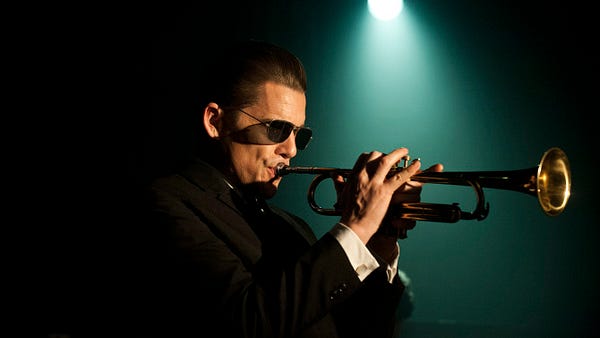
Ethan Hawke on life, work & "Born to Be Blue"

I was sitting in the dark at Nitehawk cinema in Williamsburg, Brooklyn. The film had ended. And Ethan Hawke was dropping wisdom.

I had just watched Hawke portray hunky, junkie jazz trumpeter and singer Chet Baker in biopic Born to Be Blue. The film had left me in limbo: I didn’t know what to think or how to judge. I felt conflicting emotions. Into this, stepped Brooklyn resident Hawke to talk about the movie, Chet Baker, and his own life.

Born to Be Blue plays like one of the wispy, wistful Chet Baker’s tunes that Hawke whisper-sings on screen. Chet sings about love and about not-love. He sings “Let’s defrost in a romantic mist, let’s get crossed off everybody’s list…Let’s get lost.” He sings “My Favorite Valentine” to his girlfriend, Jane Azuka (Carmen Ejogo) who he seduces from the set of a biopic in the biopic where he plays himself and she plays “The Women of Chet.” At first she can’t understand those women, then she can’t not become them. Chet has the stuff of legends, but he’s fragile, wasted, like a sparrow with a broken wing. The film shows how Baker, and those irresistibly drawn to him, try to mend his wing so he might fly again.

On the Nitehawk stage, Ethan Hawke talks like some of his famous characters. He speaks the imaginative blue streak of Jesse in the Before series and with the insight and sincerity of Mason Sr., the dad in Boyhood.

He says you should watch the film (yes, you should!) as if you’re listening to jazz: “There’s this amazing thing that happens when you listen to Chet’s music. And a lot of great jazz. It just takes your brain somewhere else. The movie should be like if you laid in your room and closed your eyes and just listened to three Chet Baker LPs in a row, what would come to mind?”

Like Chet Baker, Hawke kicked off his career young. He rose to acclaim playing the shy student in Dead Poets Society in his late teens. After that apex, he said, “You see absolutely nowhere to go. You just think that’s the normal temperature. I’m going to do a movie and it’s going to be great and everybody in the world is going to love it and everybody is going to say wonderful things about me and I’m going to actually work with wonderful, really talented people who really care about me and make lots of friends. This is a great life! Well, it’s never happened again!”

Baker got his big break from Charlie Parker, whose trumpet solos Baker played back to him at an audition. Parker invited Baker on the road. Baker soon cribbed the Bird’s heroin habit too.

Hawke talks to the challenge of staying straight and true in the spotlight. “[Chet] goes on the tour with Charlie Parker, he’s meeting everyone. And that was the key to the kingdom. Then what do you do once you’re there? How do you not turn into a rotten prince? It’s very hard. You have to actually be a substantive human being. And that is a tremendous amount of work, that most of us are not up for.”

When he talks about drugs, Hawke commends the film for resisting the urge to “finger wag” and says, “While we can all agree that drugs hurt people and poison our own roots, a lot of really good people do them." He mentions the late Philip Seymour Hoffman. "To ignore why they might choose such a path is to ignore a giant truth and to sell young people a lie. The lie isn’t that drugs are bad. They are really destructive. But if you don’t really look at why, what insecurities are driving it, then you don’t understand why somebody smart would do it.”

Few of us know what it’s like to attain princely acclaim at any age. But many can relate to feeling an inconsistency between how the world sees us and we see ourselves. Maybe we feel false for receiving external acclaim but feeling impoverished inside. Maybe we feel convinced of our own special talents, but overlooked by the world. Hawke suggests that winning and losing the fame game are often as close as adjacent cards in a deck. Each is fraught with its own perils.

Hawke advises us not to use the lottery of life to inform our values and self-worth: “There’s no rhyme or reason all the time. And so things like integrity and grace have to be their own reward. The world doesn’t applaud you for that. The world often applauds some of the most vile behavior. And that’s mysterious.” Instead, he suggests that we find value in ourselves: “Each one of us is imbued with something beautiful and unique to ourselves. For lack of a better word that’s our talent. You can piss on it, shit on it, or treat it with respect. It’s still there. It’s this thing. It’s you. It’s me. It’s who we are. It’s the essence of us.”

Saturday, October 19, 2013

I want to date...

i want to date a boy with cojones, pendulums producing forms that clash with the collective. a boy whose musk suffocates, whose eyebrows choke, whose knees cleave the warm soil. a boy whose ache for me is surpassed only by mine for him. a boy who demands but doesn't take, whose will shelters me and strips my defenses. i want to date a boy who carves me from stone, lubricates me with forlorn tears, erects a pedestal of sand at the sea's edge. i want a boy with cojones, who penetrates the pabulum, whose glance is a call to power and whose caress a call for peace.

inspired by ghostbongweedofthesamurai.

Saturday, June 02, 2012

Vampire Weekend's Contra

The proliferation of essays on Vampire Weekend’s obscurely-titled, new album–Contra–should surprise no one. The independently released album, by XL Recordings, is now enjoying the top spot on the Billboard Album Chart.

VW is the polemical double-debutante of the indie pop scene. It has an appeal like a fruity, sugary, jolly Tootsie pop – a glossy sheen of pop prowess, and a mysterious center. How many licks does it take to get to the center of a Vampire Weekend album?

There are two ways to approach Contra: To achieve the elusive center, we can either deliver a swift and severe bite, like the peckish owl, or we can bestow lick-caresses, patiently and earnestly, while the musical dye stains our tongues.

Consideration between these two methods immerses us in an age old dialectic about musical analysis. Musicologists, academic and amateur, have long debated the merits and deficiencies of discussing just the music or, alternatively, the whole musical milieu.

Method one would be the brisk bite, and is sometimes referred to as positivist, structural, or scientific. It takes the recorded music to be a discreet artifact, and removes it from its social and cultural influences.

Method two would be the languid lick-job.This might be informed by sociology or cultural studies, and it would examine the history, cultural embeddedness, and mystique of the music and musicians. Both methods are useful, inevitable, and clearly complimentary. By combining the two, we balance the analysis and can dance around some of the common criticisms – that VW is preppy, elitist, lyrically remote, or that its combination of styles, including African soukous, represents a blithe cooptation of the authentic for commercial gain.

I restrain myself from going into too much detail here, because sophisticated and in-depth song-by-song analyses have been done elsewhere, such as this one in The New York Times. VW’s music is unapologetically poppy. By which I mean, it is mellifluous, lyrically accessible, relatively simple in structure, and chock full of memorable hooks and repetitive choruses.

While the adjectives “poppy” or “mainstream” can sometimes seem derogatory–and may be valid as such – Saul Williams expresses my opinion on the subject best: “That’s only a criticism if you’re a loyalist to the underground as opposed to a loyalist to good shit.”

Is Contra good shit? From the positivist perspective, the album is a collection of songs which are relatively simple, structurally, but that does not make it uncreative. To the contrary, the gentlemen of VW–led by singer Ezra Koenig–keep the rhythm and speed of the songs varied throughout, and the ebb and flow guarantee a strong level of titillation.

Contra’s instrumentation is lush and heterogeneous, representing the cherry-picked best of American, African, and English styles. Koenig’s vocals range from the strident to the spectral. VW also pumps up the post-production, relative to their self-titled debut. Those methods are particularly effective in opening space in their laconic songs for innovation and novelty.

For instance, the distorting, Auto-Tune effect on Koenig’s voice in “California English” is a refreshing embellishment to the brisk, purportedly Afro-pop sensibility. Also, check out the yelping skat on “Cousins,”–their first single and, ironically, one of my least favorite songs on the album – the strings and–what the hell is that?–harpsichord on “Taxi Cab,” the horns on the straight-forward pop-tune “Run,” and the African drum–djembe, I think–on the ballad, “I Think Ur A Contra.”  Then “Diplomat’s Son” is musically kaleidoscopic, and the most characteristic song as an appropriate analogy for the diversity of the album as a whole.

As we lick towards the full picture on VW’s Contra, it must be conceded that the underlying diversity of the album can be a double edge sword. It implies that, for every listener, there are to be some songs which grate or bore. “Holiday,” for instance, strikes me as sub-par in its redundancy, melody, and instrumentation. It tries for a British pop-punk sensibility, but falls flat. “Holiday,” along with “Cousins,” are the two most simplistic, poptastic, and repetitive songs on the album.VW balances on a tightrope of accessible and intriguing and can easily lose its sophistication and end up sounding sophomoric. Or, importantly, this is just the part of the album that appeals least to my sensibility. Chances are that some listeners prefer these songs and dis-prefer those I find most fresh and electrifying.

Lyrically, Contra is somewhat obscure, which can also be seen as arrogant or remote by some listeners. It is erudite on pop culture and redolent of international travel and American upper-middle-classism. One can be turned off by this, but I take it to be an opportunity for education and rich interpretation.  “California English,” for instance, is packed with references: to “Hapa Club” (Hapa refers to a person of mixed Asian or Pacific Islander ethnic heritage), “carob cake” (from a tree found only in the Mediterranean) as well as a high-flying geographic panoply, not to mention Tom’s Organic Toothpaste.

VW’s music is representative of the eclecticism of the contemporary age, what with globalization and the rise of youth-inspired cosmopolitanism. The gentlemen of VW are unbounded, like the wealthy youth of the western world (and, more and more, the youth of the world): internationally minded, cultural cherry-pickers, innovative about mixing and melding.

They channel the feeling of internationalized manifest destiny which is unique to today’s millenial generation. That they are somehow elitist and prepified is undeniable: they represent a cultural trend which is rooted in wealth and the inequality of international globalization. However, to criticize them for those external cultural aspects is to create an ad hominem, which has no bearing on the discreet artifact that is their recorded music.Those that emphasize the relevance of this fact, more often than not belong to and benefit from the same generational and cultural mold.

The fact that VW’s music is called “Upper West Side Soweto,” and derives influence from Congolese soukous is an object of interest, but more importantly, integral to the band’s commercial success. We do not care all that much what soukous is or what elements of it are in VW’s music. If we have dire fears of cultural imperialism, the hegemony of commercial capitalism, or the cooptation of the “authentic” for the sake of the “artificial,”  they are not reflected in patterns of musical consumption. We just like the music and adore the international flair, the sheen of mystery. Unlike the contra-revolutionaries of late 20th century Nicaragua, we are contra-nothing except bad taste and mediocre music.

Vampire Weekend has done a particularly good job of exploiting our (some combination of American; international; youth; upper-; middle-; class) omnivorous multiculturalism, growing apathy and agnosticism towards origin and authenticity, and our inherent privilege and prepiness, even in those who do not dress like Oxford dons.

-Note: Reprint from when I was editor and contributor at WERW 1570's student radio and music blog at Syracuse University. Contra was released January 12, 2010. My show was called Brad and The Unbounded One.

Thursday, March 01, 2012

The Books noticed me

Something amazing has probably happened. The refracted light of maybe-greatness has struck me dumb. Here are the details:

I saw a concert by The Books at Cornell Cinema, Ithaca, NY on March 31 2010.

Then I wrote a reflective article (see the previous post) on the experience and The Books artistic process for my radio station's blog at Syracuse, WERW 1570 Word Press, of which I was editor.

I posted the following blurb on The Books' Facebook fan page.
Though heroically unlikely, I'd love if you (The Books, but also anyone else) would read my (pseudo) intellectual piece on your music and show of March 31st at Cornell. Found here.
Yesterday Nick Zammuto or Paul de Jong of the duo The Books or somebody else representing The Books or representing Zammuto's new project read the article and wrote:
Bradley... thats such a bad ass article you wrote man! seriously... one the best i ever saw! good work! Please take some time to check out Nick's new project... the new album comes out April 3rd 2012 under Temporary Residence! hope you enjoy man!
I responded:
This really means a lot to me. It really does. I had a saccharine freak out, flying around the apartment whooping, smiling like enlightenment. And as verbose as my old writing is. And my new writing, come to think of it. Thank you for the attention and the kind words. All best wishes to both of you and best of luck on the new venture. You have my support.
I hope it wasn't mere promotion and that somebody (preferably Zammuto or de Jong) actually read the piece and means what they wrote. It's nice to be recognized, especially by those you admire.

The Books: collectors and collage makers

It was a soggy evening. We were late, but only barely. Our tickets greeted us at the door. Our seats were up a coiling stairway into the bowls of Cornell Cinema, Ithaca, NY. I had gone for a preparatory pee, and let my companions precede me. When I entered the murky second-tier seating, I was ambivalent to discombobulated isolation. Music and video assailed me: The Books in full 2D, 3D, and auditory assault.

The Books are a New York City-based duo, consisting of Nick Zammuto--guitar, vox, bass--and Paul de Jong--cello with great vigor. He broke a string during the performance (and also played bass on one song). Live, they jam over and in sync with their electronic music. Synchronized videos act like pulsing semaphores, conveying independent messages and impressions. The overall effect is stunning and distinctive. For me, the songs and videos bled into one overwhelming and mesmerizing farrago.

The Books are masters of recreation and transformation – what they have deigned to call “auditory mosaic” or “collage music.” They think little of disciplinary or stylistic rigidity, and they are unlikely to be dogmatic about much of anything except originality and quality. They are mixed-media innovators and tinkerers. Zammuto claims to have installed amplifiers in filing cabinets in order to explore metallic resonance. Their art and speech are redolent of eclecticism and artistic postmodernism.

During a Q&A session after the Cornell set, Zammuto mused on the role of language: its inevitable and undeniable power and yet its certain sterility and inherent limitations. It is, he claimed, the best single tool for human communication, but it still can't beat the whole toolbox.

For The Books, language is crucial to song and video composition. However, the words they sing and embed as electronic samples do not primarily explain, predict, or commentate; Zammuto rejected the view of their music as social and political utterance. In this sense, the words they use constitute one of many instruments, used to evoke a range of intellectual and emotional responses – awe, humor, curiosity, etc. And instead of invent, evaluate, and pontificate, The Books collect and they channel.

Zammuto touted de Jong aptitude as a “great collector” of words and not just video. They collect material from thrift stores, even collaborate with other collectors, and mine information from prosaic situations. Their track "Motherless Bastard," they claim, uses real-time video and audio recording from a fast food restaurant.

Be that as it may, language and video in The Books invoke emotion in a way distinct from, say, one of de Jong’s cello solos. Creative force and selectivity guide their composition process. And deciding what to show and not show, how to arrange, distort, and emphasize imply a purpose which is more profound than exhibitionism. There's no escaping artistic intent. And as much as they try to counteract or discount the view, Zammuto and de Jong recognize their role as politicized, social commentators.

The song “Be Good to Them Always,” demonstrates the point. The lyrics are, “I can hear a collective rumbling in America/ I’ve lost my house, you’ve lost your house/ I don’t suppose it matters which way we go/ This great society is going smash.”

Naturally, when I heard this song for the first time in Winter 2008, I assumed it was new – composed and recorded after the big bust. In fact, it is from the album “Lost and Safe,” released in 2005. I then, ahistorically, thought of the lyrics as eerily prescient. But even this view is befuddled. The lyrics are sung in concert with dialogue samples from the-devil-knows-when. Ergo, the samples and thus the song had no intended connection to today’s economic ills. They can't have. And yet, the song is both relevant and timely.

The genius of The Books consists of uniting disparate samples, re-casting them, and embedding them in a new context. Their method would be analogous to that of the antiques collector but for their general agnosticism toward origin. Jean-Luc Godard was supposed to have said it: "It's not where you take things from--It's where you take them to." The Books strive more to create a new and stimulating combinatory artifacts than to comment on the understanding of the past, or present, or future.

Sitting in Cornell Cinema, all senses attuned, I found my brain clouded by thoughts – unfortunate distractions, which interjected themselves between me and the performance. The intellectual and social components kept cropping up, forcing me to translate my experience into language. What did I really think? What was I feeling? What was I going to say to my friends during the unavoidable post-show break-down?

I couldn’t escape these thoughts, and yet I kept reflecting that the kaleidoscopic performance was beyond words; that words were woefully inadequate. I finally abandoned the intellectual exercise, and yielded to the music, the videos, the faces of the performers, the furious pumping of de Jong’s leg keeping beat. I let the full range of emotions overmaster me, and decided that if talk was called for later, I'd recall, ruminate, craft some response.

But when it came time to dissect the show, walking back to the car in the rain, murmurs of wonder and appreciation were forthcoming, but there was surprisingly little to say. The Books had said it all for us.

-Brad Turner, of Brad and the Unbounded One, Wednesdays 9-11pm on WERW
Originally 3 April 2012, WERE Blog

Monday, August 08, 2011

Pop music

Of a sudden, I am strangely and ashamedly enamored with pop music: Rihanna. Katy Perry. Lupe Fiasco. Taio Cruz. etc. The culpable parties are "fireworks" and "exercise." Allow me to explain.

On the 4th, I watched New York City's Macy's-sponsored fireworks display on television, with my parents, in my basement. Evincing incredible cleverness, the producers jammed Katy's "Firework"  and Taio's "Dynamite" during the show. All in all, it was an impressive set-up. I immediately downloaded the songs.

Subsequently, they infiltrated my exercise mix and imposed hegemony. Over time, the population of nakedly poptastic singles procreated and diversified. Madonna is represented.

Most bizarrely, I find that I hanker for Rihanna's "Rude Boy," which is among the most sexually explicit and, to be fair, super-sexy tracks I know. The video may partly explain my interest.
This is a drastic reversal. See, I have a memory of this song. I was in a work van, listening to the radio, on my way to tutor at a downtown Syracuse city high school. The track came on and literally disturbed me, I had no idea who the artist was, and I recall later describing it to a friend in exasperation, disgust, and befuddlement. "This is what we've been reduced to!?" It was cataclysmic. And now it's on repeat during exercise sessions.

This interest in base pop music is paradigmatic of an overall shift towards consumptive anti-gourmandism. I'm embracing my intellectual roots: Jeremy Benthamite utilitarianism (cosmo-consumption) but with a bit of the garbage disposal thrown in. From a certain perspective, it will seem that all is going downhill, down with the Bradstreet.

Actually, what's transpiring is ancient. It's my life story. Octopus hands all on me, multidirectional tugging.

Lupe puts it proper: "One day we're listening to N.W.A, the next day we're listening to Ravi Shankar." One day, it's goat utilitarianism, the next, it's Cartesian dualism... well, not really, but y'all get the point.

Saturday, February 12, 2011

Cosmo-consumption: liking “everything” and meaning It


You will have noticed how counterproductive it has become to ask, “So, what kind of music are you into?” Invariably the respondent – as sick with this question as you are – answers, “You know, like, everything.” And they’re ingenuously and more or less correctly representing their preferences. There’s nothing wrong with this answer; the inanity is in the query itself.

Allow me to approach this question of “everything” from an analysis of “a little less than everything.” Despite my claim above, sometimes the respondent feels like reducing the field. Thus, to “everything” they might add, “… except country and/or rap and/or electronic and/or some other type of music.” By arguing that this sort of categorical reductionism is questionable, I hope to show the utility and veracity of the “everything” answer.

There are two reasons why I think eliminating whole genres of music from one’s repertoire is foolish: (1) ignorance and (2) hybridization.

Clearly, no person can catalog, interrelate, and understand the wealth of music that exists today. Yet, when someone claims that they dislike a certain genre, it is assumed that they know the genre. Consider quantifying “knowledge.” On a rule of thumb basis, how many artists from a genre would you expect somebody to “know,” before you would certify them knowledgeable about that genre? I think a lax lower-bound would be twenty artists.

Now try to list twenty artists belonging to a genre you like. This can be as vague and prodigious a category as Rock, Funk, Hip-Hop, Jazz, or Electronic – the genres I chose. When you have completed this challenge, try the same exercise for your ambivalence or punching-bag genres. For me, completing the first five was less than effortless, but I failed Country (miserably) as well as Soul (which I adore; see results below). Obviously, people  know less about genres they claim to dislike than those they claim to like. But, how can you dislike a genre you don’t even know?

My claim is that when people decide to narrow their field of musical preference with a categorical exception, they almost always do it in a state of ignorance. If the former experiment does not convince you, test the next person that evinces this behavior. Take them to task. Undoubtedly they’ll complain: there’s no incentive to know about a genre that you dislike; they’ve heard the music, they just can’t produce names; and it’s common knowledge, after all. Everybody knows what Hip-Hop, Country, and Electronic music more or less sound like, don’t they?

The answer is a radical “NO!” No, they do not! Even a person cognizant of twenty artists in a genre does not know the genre. Any umbrella category such as the ones discussed here is best characterized as vastly heterogeneous. There may be recognized pioneers, paradigmatic artists, and common technical elements, but there is no representative sound. Knowledge is scarce, and rejecting a musical genre from a state of ignorance is preposterous.

My second reason for rejecting genre reductivism is also illustrated by the exercise above. When you list twenty artists according to genre, you inevitably find boundary-stretchers and outliers. These are more often than not some kind of hybrid. Artists almost always represent more than one genre. Sometimes, they hybridize so weirdly that they do not seem to fit anywhere (this is common: I suggest The Books and Matmos & So Percussion).  In any case, all genres significantly interpenetrate and overlap. There is no purity. One cannot limit the contagion of an unliked genre by will alone.

If you follow my argument thus far, you should be convinced that reducing your field of “liked” music from “everything” to “everything but…” is a dubious and somewhat arbitrary practice. If you’re like most of the people I’ve queried about their musical tastes, you are probably much closer to liking a little bit of everything than you are to responsibly amputating swaths of the spectrum. 

This, I think, is one of many idiosyncratic and positive features of the past couple decades and the modern cosmopolitan, aesthetic outlook. Of course, it’s not without its controversy – it’s caught up in debates about the authentic, cultural imperialism, inequality (because ‘cultural’ range and sophistication are usually predicated on wealth), and a whole host of unmentionable post-isms. In short, lots of stuff to think and write about in the future.

If I am dogmatic about expansive tastes, well, one has to stand up for something. I am a fan of liberal draughts of trying and tolerance. Of course, I concede that one can be rationally picky or dislike something through relative disinterest. Nonetheless, I beg you, be wary. Explore a genre patiently, expansively, and with an open mind before you write it off. You may find that what you thought you knew was just stereotype and caricature and that what you thought you liked can be nourished and grown almost without bound.

See expanded text for "Super fun game!" and my results.

Friday, February 11, 2011

Words to live by


I recently noticed how much of my prosaic philosophy corresponds to innocuous song titles and lyrics (and a Movie quote). Although the implications of this are deep, in this article, I will not expound on how our identities are formed by the constant buffeting of structural variables. Instead, I will lay out a couple examples of this phenomenon for your perusal, and allow you to draw your own conclusions. As always, I invite you to share your own experience and comments.

1.”Todo cambia” – Mercedes Sosa “Todo Cambia”
I begin with a bit of banality. It is well known that everything always changes. Big deal. I agree, but don’t let the banal obscure the profound. It can be enriching, from time to time, to ponder the fact that everything we know is mutable and transient – perpetually shattered and recombined into new forms. The human order slides towards discord. Furthermore, one might note that what we conceive of as precious is invariably fragile, transient. To some degree, love emerges from fear.

2. “Everything In Its Right Place” – Radiohead
In stark contrast to the first quote, this lyric is about my personal quest for order. In my petite studio apartment, I obsess over tidiness and harmony, not in a feng shui way, but in a Stalin way. It’s not about energy flow, it’s about control: I’m a totalitarian about my body and environment. On occasion, jeans slip down to one or the other side of the hanger; anarchic socks and shirts scatter across the floor; food sours in the fridge; fingernails rebel intrinsically. In short, everything needs to be put in its place – it’s right place. And I go on organizing, battling fruitlessly as the dust accumulates with ambivalence, sure of its inevitable glory.

3. “I Need a Woman!” – Federico Fellini’s Amarcord
I know I’m not the only one who, when single, feels like roosting in a tree and yelling out an impassioned but fruitless, “I need a companion!” (VOGLIO UNA DONNA!) This is at least what the “mad” Uncle Teo does in Fellini’s slow-moving, autobiographical memory flick. I find his words appearing on my lips from time to time.

4. “Get it Together” – Tm Juke feat. Bread & Water from Maps from the Wilderness
TM Juke is a UK-based producer of hip-hop, soul, and electronica music. Bread & Water is ostensibly a rapper or hip-hop group about whom I have no information. The track speaks, to me, about the failure and insecurity that stalk all of us at one time or another – about times of despair when you feel  you just “need to get it together.” The song conjectures that we’re all prone to such moments on occasion, and counsels modesty, detached self-appraisal, and eradicating sources of negativity. Without abandoning hope for advancement , Bread & Water recommends being cool with the status quo. Although this is obviously easier said than done, this song helps soothe the demoralized ego.

5. “I Feel it All” – Feist
Far from a Buddha-like detachment, I routinely find myself walking on affective embers. At such times of emotional super-sensitivity, I may yearn for an emotional tranquilizer or an effective distraction. Of course, I would never actually dope away my sensitivity. I’d rather “feel it all” than “feel nothing.” Which leaves us with one of those ubiquitous Goldilocks conundrums: Not too hot, not too cold… just right! But that facile formula doesn’t take away the pain during the down-in-the-dumps days. Neither does Feist, but her message does contextualize emotional stress and control in the locus of sensitivity.

Friday, January 07, 2011

IOU for borrowed music

Who actually pays for music any more? What are the ramifications of the free-marketization of contemporary music? I've always felt in my gut that obtaining music by Napster, Limewire, Soulseek, Bit Torrent - even potentially by interpersonal transfers - is wrong. Everybody knows that artists, musicians included, have to make that bread and butter. Downloading produces little to no direct revenue for the artist. It's stealing.

There are regular rejoinders to this argument. For one, artists find other ways to make revenue. Back in the day, artists would play shows to get people to purchase their CDs. Now that the latter is a no-go, do they disseminate their music for free or on the cheap, or look the other way because it is beyond their control, hoping that more people will pay to attend their concerts? Personally, of all the bands whose music I have downloaded or been given free of charge, I might have been to concerts for about 1% of them, or less. I don't know about you, but I think this is a pipe dream, an illusion, and a rationalization.

In another vein of complaints, it is claimed that artists do not receive revenues from CD sales; record companies do. This may be true for the big concert blockbusters and/or indentured servants of some of the bigger and more predatory labels. Yet, even before the proliferation of independent gigs and artist-generated and -managed labels, it is fallacious to say that artist's received little to no profit from record sales. Some did and some did not. Either way, both bands and record labels serve artistic and economic functions which deserve market remuneration.

Then there was the "I'm just trying the music out, man" argument, which really was always bunk, and which has been definitively nullified by Youtube, Last.fm, Pandora, Spotify, and listening stations at Best Buy and other music shops.

Finally, there's a technological determinism argument: free music or novel, internet-particular ways of dissemination are the way of the future and should therefore be accepted. If everybody's doing it, and it only seems to be becoming more rife, why not me?

I'm putting more work into convincing you that free downloads constitute theft than I had initially intended. I am myself one of the most prolific thieves on the interweb. I feel perpetually guilty, understand the moral cost of these violations, and hope to one day make amends. In fact, the intended point of this post is: artists should have remuneration drop boxes. Ideally it would work something like this: while poor, we steal. When we make money, we pay back. It's like an honor code IOU system for art and music consumption.

This makes sense given the current and recent historical inadequacy of protections on intellectual property, especially music.

Here's one of my recent acquisitions. Rest assured, the artist - Portico Quartet - is on my IOU list. I hope that by the time I've obtained an income flow, my drop-box remuneration idea will have caught on. Otherwise, I hope snail mail is still operating: I'll send my contribution to these Brits in the post!

Thursday, September 02, 2010

FB reg and rap

Somebody once said that greed is a fat demon with a small mouth. One could say the same thing about Facebook. It's remorseless, implacable, as addicting and pernicious as a drug. Of course, it is a drug. Like bottomless obsidian. Do I use it as a social crutch? Well, no. But that doesn't mean I'm not dependent on it. Seduced by its wiles, its convenience, and its ubiquity, I can't give up. I'm one of the die-hards, a true user. I suppose most people are, but...

I take it to the next level, a higher echelon,
like while you get all equestrian, I stampede you on my mastodon.
Dosing through the eye, I hit-it 'til my retina crinkle,
pupils dilating like pancakes, psychedelic dreams like Rip van Winkle.
The screen is a mirage, Zombie Wars populate,
lost in family-tree cultivars, I'm the number one reprobate.

[Zuckerberg's my fan, it's all part of the plan!!]

I perambulate the cyberspace with stamina,
droppin' wicked diction, breadcrumbs of discernment,
poking mothafucka's like I'm stabbin' ya.
(Feeel my wall post lacerations!)
What I do best is stalk benevolent, cruise the news feed like a stealth jet,
aloof but not hidin', not frettin' just checkin' in,
ridin' the hype until the moment is ripe.
Then I doseify! (yeah!), I like to get high!,
'til I can't decipher cyber from matter (O shit...),
space from face, book from bewitchment,
person from profile.

All of a sudden I'm feckless, (is this a test?)
Hip to nothing in this anti-social labyrinth,
No rest, no reprieve,
and ignant of my location -
Fickle-framed fantasy-land or home (whatever that is...).

...Facebook rule immediately in effect- one sign-in per day. I'll report back to the success of this campaign. Obviously, this campaign failed, now it's the future, I cancelled and resurrected the account. The future Facebook still has the gonads in a vice.

Friday, May 28, 2010

World of musical medley

What in the name of shaven Shiva is World Music?

This term is generally understood, but it is also generally understood to be an egregious misnomer. It suffers from poor semantic vision and lacks usefulness, largely because it has no antipode. Nobody listens to music which qualifies as non-world. We have yet to receive melodic, rhythmic, or lyrical transmissions from alien races or species. No Martian jazz, Plotonian hip hop, or back-country bluegrass from Betelgeuse. This is lamentable, but undeniable. After this blog, it is conceivable that my next project will be to write a science fiction novel about an interplanetary musical interchange (IMI), and how music eventually defeats the human specie's knee-jerk xenophobia . O, someday... But for now, all music is literally world, or rather planetary. And, because it is planetary and distinctly human, it is all generally comprehensible.

We like our art to fit into the comfortable boundaries of our aesthetic experience, but we appreciate it when it toes the line of convention. There is a safe band of space between bland, craven convention and weird, envelope-shredding experimentation. Societal and personal change occur gradually; innovative mutation is a lengthy process. One does not generally go from the Beatles to the Swedish thrash, death, and prog metal band Meshuggah in one revolutionary leap.

Where, then, does world music fit in on the all-musical spectrum? First, we must reject the cheeky, buffoonish “All music is world” thesis, because it negates even the conventional social value of the term world music. We then move on to a new theory. Perhaps, only music which is unadulterated, indigenous and traditional should be called world music. This is a radical and untenable position. A more moderate perspective is that the mix of modern and traditional constitutes world. From that perspective, world music occupies a space between generally well-known Western modern music and generally unknown indigenous folk and traditional musical trends.

I choose the latter, because I consider purity to be a fiction. The unadulterated is sullied everywhere, especially now given pervasive globalization. Modern cultural mishmashing makes delineating useful boundaries around potential sanctuaries of pure indigenous music or art difficult and or impossible. If that sanctuary is out there, it is buried beneath the slow, drifting sands, or crouched with a spear in its hand, in some tropical jungle. From my perspective, the indigenous flavor worldizes, and the modern flavor dilutes, if you will. Creative destruction rules, and the synthetic production is our lot, and it is valuable. We live in an age of univerally worldized, slightly-othered, and obviously commercialized music.

The international hodgepodge leads to my argument about why I believe that any individual can like any kind of music. One must only put one's mind to the task. There is only the single human musical family, and human beings should be open to its widest range and scope. I am one non-discriminatory soul, with wide open acceptance for the potentiality of universal musical enjoyment. Therefore, the sonorous sounds of African or Japanese percussion, Andean folk, Brazilian bossa nova, European lo-fi electronica, and American pop-rock soothe me or excite me in ways that are completely analogous.

The underlying concerns to this discourse are the inequality of global power structures and the purported Westernization of the world. One thing can change another without itself being changed, but power differentials make meaningful cultural imperialism a real possibility. We want a variegated hybrid, not a monochrome blob.

(taken from a WERW Radio Blog posting, by me, found here).

Friday, April 02, 2010

Radio shows FOR DOWNLOAD


Finally, for the first time, available for popular consumption: THE UNBOUNDED ONE as heard on 1570 WERW RADIO, Syracuse University, Syracuse, NY.

Shows (list to be added to and amended): Funk  (March 10, 2010), The Kids (March 24, 2010), and Africa (March 31, 2010).

Persist my precious sweetums, be free and propagate; impregnate the fecund minds of friend-followers and music-lovers alike; be consumed and enjoyed.
Get the music at my Mediafire: UNBOUNDED

Thursday, March 04, 2010

I am disk jockey

Did you know that my delusions of grandeur have invaded the airwaves?

That's right, I have impregnated the radio with a worldized, Bradified mix of every thang and no thang. My show is called "Brad and the Unbounded One," and is a weekly featured fixture on WERW, broadcasted on iTunes Radio out of Syracuse, NY.

A note on the name: There is no exact "Unbounded One." And, I hasten to add, it is not separate from me. It is me and the unbounded one, together, immanent, belonging to each other, composing mutually subsuming circles in a Venn Diagram. In fact, there is no limit to the seep of the show - it consumes and reproduces everything which comes in contact with me, my music, the cultures which generate, the listeners, and all of the interconnections. Pantheism would imbue this pulsating ball of yarn with the name "God" or "The Deity," but I am content with referring to it simply as "The Unbounded One." My show, my language. Nevertheless, it deserves respect.

The show, to be true to its moniker, lacks definition or limitation. It is veritably ecclectic and exploratory. Shows need not have a tight focus (e.g. can be unhindered medleys, mixes, and adult anonymous), but often do (e.g. funk, long and short, the kids, electronic and rap, South America).

I unfailingly incorporate recommendations of songs, artists, and themes into my shows, however those kinds of things are in short supply. I get relatively little support, critique, or collaboration, despite my constant petitions for such. I need it not, but assume it would make the show more truly unbounded and participatory.

I am obviously an amateur, but I put a shocking amount of time into preparing for and producing the show every week. An influx of listeners would be gratifying, and would make more worthwhile the effort expended. Then again, you cannot always have what you wish for, and sometimes you have to work to improve your lot. Shows will soon be appearing on the interweb, for ready pod-cast-like listening - hopefully. And, an ad is in the works, though highly dependent on collaboration.

For now, I march forth, creating my own weekly emission, and striving to make the show even more stellar than it already is.

As always, be unbounded.

Sunday, July 26, 2009

Music

O what a power music has! O what an emotional umph! When I say emotional umph, I refer to music’s uncanny ability to alter mood and mind in subtle-gradual and revolutionary-rapid ways. This is no secret, no mid-night revelation, but rather a universally recognized reality. I believe that every person who appreciates life appreciates music. Naturally, some cherish the art of sound more than others. But it pervades! It persists! Music has an unmistakable power, akin to a spectral shape-shifter. Its influences reflect its diversity, covering the infinite spectrum of sounds, words, and emotions.

Cognitive and emotive functions identify trends and bend to the purpose of a particular musical piece. Watch as music gusts about, shaping and inspiring: mood, thought, dance, guttural shouts and grunts of gratification, and, most importantly, new music. We employ a certain exponential function to graph music's growth propagation.
We are beings of sound. And art. Art subsumes music and is hence of greater scope and broader domain. Art is life, but life is not necessarily art. Embrace the art of life. Saul Williams says that music is our alchemy and orders us to find our mantra and awaken our subconscious. The rest his poem, Coded Language, is utmostly pertinent, however I desist from total mimicry and leave you to discover him for your selves.

This post was inspired by a song by some Brazilian musicians, which irresistibly urged me to discard a feeling of malaise and create a tribute to their harmony. See the art that art has stirred!?

Given the power of art and our natural creativity proclivity, how can we resist satiating our artistic selves? Ignoring our natural ability disserves our selves as well as the selves of our fellow beings. Embracing and celebrating our manifested proficiencies makes for color, light, and lovely, where we would otherwise observe drab, dark, and boring.

Friday, December 12, 2008

The case of the Tra La La Blip

Well my friend followers, Christmas break has come. Based upon past experience, I expect to see a proliferation of free time for all. This gives rise to potential for rousing change. In the spirit, I think it apt to diversify this blog. I do not know what that foretells.

Anyway, today I want to tell you about a musical project. There is group called Tra La La Blip. It is good. Tra La La Blip is composed of a collective of musicians that live in New South Wales. They produce unique self-described loop-electronica/pop/other music. They are good. They all suffer from some "intellectual or physical disability." Their music production process, called the Soundbeam Sessions, was facilitated by musician Randolf Reiman. It is good. I suggest strongly that you take a peek with an open mind and in the spirit of inspiration-seeking. Listen to the music. Look at the pictures. See if you like it. Report back!

Sunday, November 02, 2008

A prescient prediction: daylight savings time, now

I have deduced from a protracted period of clock-watching that the world fell asleep this morning and lost an hour. This would normally be fantastic, for I would be receiving an hour's extra sleep, but I am awake. Furthermore, I am set to meet a friend to make music this very morning. I cannot exactly say when I am set to meet him, whether in 20 or 80 minutes. The world is in disarray. The space and time continuum has been ruptured, some time slipped away. Even if he is as perceptive as I, he might decide not to show up at "8:30." This is a conundrum, a psychological guessing-game, and very much some stinking shenanigans. Why was I not told about this? I really would have appreciated a national update. I will be one of many wronged and confused mofos on this day. Fuck the merchants.