Thursday, August 18, 2016

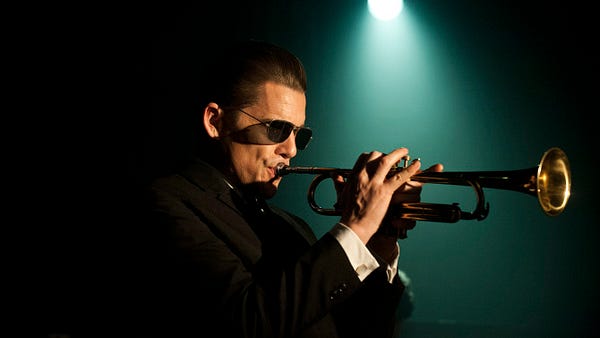
Ethan Hawke on life, work & "Born to Be Blue"

I was sitting in the dark at Nitehawk cinema in Williamsburg, Brooklyn. The film had ended. And Ethan Hawke was dropping wisdom.

I had just watched Hawke portray hunky, junkie jazz trumpeter and singer Chet Baker in biopic Born to Be Blue. The film had left me in limbo: I didn’t know what to think or how to judge. I felt conflicting emotions. Into this, stepped Brooklyn resident Hawke to talk about the movie, Chet Baker, and his own life.

Born to Be Blue plays like one of the wispy, wistful Chet Baker’s tunes that Hawke whisper-sings on screen. Chet sings about love and about not-love. He sings “Let’s defrost in a romantic mist, let’s get crossed off everybody’s list…Let’s get lost.” He sings “My Favorite Valentine” to his girlfriend, Jane Azuka (Carmen Ejogo) who he seduces from the set of a biopic in the biopic where he plays himself and she plays “The Women of Chet.” At first she can’t understand those women, then she can’t not become them. Chet has the stuff of legends, but he’s fragile, wasted, like a sparrow with a broken wing. The film shows how Baker, and those irresistibly drawn to him, try to mend his wing so he might fly again.

On the Nitehawk stage, Ethan Hawke talks like some of his famous characters. He speaks the imaginative blue streak of Jesse in the Before series and with the insight and sincerity of Mason Sr., the dad in Boyhood.

He says you should watch the film (yes, you should!) as if you’re listening to jazz: “There’s this amazing thing that happens when you listen to Chet’s music. And a lot of great jazz. It just takes your brain somewhere else. The movie should be like if you laid in your room and closed your eyes and just listened to three Chet Baker LPs in a row, what would come to mind?”

Like Chet Baker, Hawke kicked off his career young. He rose to acclaim playing the shy student in Dead Poets Society in his late teens. After that apex, he said, “You see absolutely nowhere to go. You just think that’s the normal temperature. I’m going to do a movie and it’s going to be great and everybody in the world is going to love it and everybody is going to say wonderful things about me and I’m going to actually work with wonderful, really talented people who really care about me and make lots of friends. This is a great life! Well, it’s never happened again!”

Baker got his big break from Charlie Parker, whose trumpet solos Baker played back to him at an audition. Parker invited Baker on the road. Baker soon cribbed the Bird’s heroin habit too.

Hawke talks to the challenge of staying straight and true in the spotlight. “[Chet] goes on the tour with Charlie Parker, he’s meeting everyone. And that was the key to the kingdom. Then what do you do once you’re there? How do you not turn into a rotten prince? It’s very hard. You have to actually be a substantive human being. And that is a tremendous amount of work, that most of us are not up for.”

When he talks about drugs, Hawke commends the film for resisting the urge to “finger wag” and says, “While we can all agree that drugs hurt people and poison our own roots, a lot of really good people do them." He mentions the late Philip Seymour Hoffman. "To ignore why they might choose such a path is to ignore a giant truth and to sell young people a lie. The lie isn’t that drugs are bad. They are really destructive. But if you don’t really look at why, what insecurities are driving it, then you don’t understand why somebody smart would do it.”

Few of us know what it’s like to attain princely acclaim at any age. But many can relate to feeling an inconsistency between how the world sees us and we see ourselves. Maybe we feel false for receiving external acclaim but feeling impoverished inside. Maybe we feel convinced of our own special talents, but overlooked by the world. Hawke suggests that winning and losing the fame game are often as close as adjacent cards in a deck. Each is fraught with its own perils.

Hawke advises us not to use the lottery of life to inform our values and self-worth: “There’s no rhyme or reason all the time. And so things like integrity and grace have to be their own reward. The world doesn’t applaud you for that. The world often applauds some of the most vile behavior. And that’s mysterious.” Instead, he suggests that we find value in ourselves: “Each one of us is imbued with something beautiful and unique to ourselves. For lack of a better word that’s our talent. You can piss on it, shit on it, or treat it with respect. It’s still there. It’s this thing. It’s you. It’s me. It’s who we are. It’s the essence of us.”

Saturday, April 30, 2016

On hands

Sometimes I look at my hands and see stunting. I see my dad’s hands, my brothers’ hands. I see their statures. Their hands are broader and digits longer, their bodies taller. I see my hands covered and made diminutive, they shrink in comparison, and I shrink with them. I see what could have been, me standing statuesque and grand, hands like hams dangling on orangutan arms.

Sometimes I look at my hands and see my hands. I see scaly dermis, dessicated webbing, bashed fingernails. I see the index shake. I see where in high school I tried my resolve with a lit cigarette. I see drums in abductioned thumbs. I see rough rocks and vibrating roundwounds in pocked callous coverings. In gathered palm, I see vessels of water uplifted, morning ablutions, satiating slurping. I see aqueducts flushing blood from shirtsleeve to wrist to digit entwining. I see handshakes. I see lines that lead to fortuitous futures. I see myself grasp a pencil, pack a snowball, knead thighs, juggle pins, pledge allegiance.

For a time, I saw hands everywhere. I saw club thumbs, stunted and decapitated digits, scars, tattoos, bitten nails, sinews. I saw hands in all manner of shape and size, all manner of human hue: roasted coffee, clotted cream, cedar, humus, ivory, butterscotch. I saw potent hands, penitent hands, dry hands, turgid veins, parchment skin. I saw all species of adornment: tiny spoons wrapped 'round thumbs, gigantic runner’s watches on wrists, fingernail paints and patinations, wedding bands on ring fingers, multi-finger rings, not to mention gloves of all sorts, which hide hands. Beneath these and other burdens and beauties and buffers, hands abide. I saw hands that had performed baptisms, held guns, hefted beams to scrape skies, hands that painted hands, absent hands, tiny hands, ancient hands.

I suggest you see hands, not the least your own. Hands may be dumb instruments but they work wonders, tell stories, and hold the weight of the world.

Friday, April 15, 2016

Practicing compassion and forgiveness

Edith D. Hill: "After healing, comes living."
Rune Lazuli: "You want to perform a miracle? Forgive yourself."

Forgiving and healing are not discrete, terminable acts. They're processes that lead one into another. Wrongs make wounds. Forgiveness makes healing: covers the wound to restore the relation.

I wound the bond to myself just as to another. I am singular but divided. I can appeal to myself to heal myself.

To forgive, I take responsibility in understanding. I acted for reasons if not reasonably, according to an ethics if not ethically. I use compassion to find learning and forgiving and move on. That way, the past is passed on to the present and can be worked into a better future.

As soon as I forgive myself for transgressing against myself I commit another transgression. I always will. So I build forgiveness into practice, ethic, attitude, awareness. I allow forgiveness to drive everyday decisions.

Scar tissue is insensate, not an armor, a numbness. Feeling is living. Forgiveness that leads to right acting leads to healing and enhances the living.

Let forgiveness fan the feeling that is living into a furnace.

Thursday, February 04, 2016

Right awareness

The mind is the first and foremost front in the war of getting what you want.

Many rightly link thoughts to words, words to actions, actions to habit, habit to character, and character to outcomes. And many rightly say change what you can and tolerate or transmute what you can’t.

We exercise utmost control in our thoughts, as nowhere else, and can there gird ourselves against external struggle and adversity, and make our minds the seedbed of serenity and success. Yet more often than not the mental palace is a house divide unto it self: it teems with fear and self-doubt, and small challenges and disappointments create turmoil.

One way to change your thoughts is to strive to cast adversity as opportunity. Take traffic. Traffic sucks. Traffic delays, disturbs, wastes, encroaches on our arrow-focused, little efforts. Traffic makes us feel like a pawn, one among multitudes of pawns. Where are all these drones, ourselves included, off to anyway? Traffic incites self-deprecating and second-guessing, causes us to regret snoozing, shower languishing, or coffee lingering, because if only we'd arisen at cockscrow, we'd damn well be there by now! Traffic sucks you from positive and productive thinking into a pit of distraction, frustration, anxiety despair.

While we may avoid traffic, once we're in traffic, it's too late. All we can manage is our mental response. There, we are master. Each time you resist the suck, you further fortify your mental palace into a mental fortress.

With right awareness, you can convert mistakes and failure into challenge and success. The character Somni-456 talks about this in David Mitchell's time-and-space-spanning novel Cloud Atlas. (For context, a sony is a computer. Go is a strategic game like chess.)
Well, Hae-Joo probed, what did I do to relax?
I play Go against my sony, I said.
“To relax?” he responded, incredulous. “Who wins, you or the sony?”
The sony, I answered, or how would I ever improve?
So winners, Hae-Joo proposed, are the real losers because they learn nothing? What, then, are losers? Winners?
I said, If losers can exploit what their adversaries teach them, yes, losers can become winners in the long term.
Cast adversity as opportunity to create solace inside from inside, and you will find it in pursuits outside.

Tuesday, December 22, 2015

Not lost

Thus we fling into successive siftings:
Tremulous on the edge
Gleaning, leaning, teetering,
Kissed by the wind,
Of a sudden, all in,
Down and bouncing down,
Among slag and slough,
Cornice and crevasse,
The paths of ancients,
Seeking, who knows,
Earth, place, rare arete.

And when the day is done our wayward pebble,
Adopts sun as tutor and softly settles,
With alike bunch in a friendly groove,
Only to, when prompted, launch anew!

When will our loose-footed friend,
Immensity's implacable pull forefend,
And giving up the day declare,
Advent to a single-state affair?

--
And for a similar tale, see this account of the The 25-Year Riverine Journey of a Wooden Boulder Carved out of a Felled 200-Year-Old Oak Tree.

Monday, September 14, 2015

Meeting house meditation

Quietly, for a time, I replace,
My striving ego with a state of grace,
Shuffle my insecurity, doubt, and fear,
And place them on a burning bier,
And in the emptiness descry,
The luminosity of an open sky. 

Sunday, August 02, 2015

Challenge yourself

To entertain yourself, to impress yourself, to daily go "dude, you're awesome," to attain equipoise, to stay focused, to discover the taproot, to respect others, to respect life, to minimalize, to go for goals, to accept the blows of the hammer, to take lightly, to be the foam of the wave, to not despair, see humor in it all, to learn, to express, to well rest, to dance with values, to know thyself, to be compassionate, to take responsibility, to say no, to shut doors, to dance, to humiliate yourself, to make commitments, to embark, to settle in, to explore landscapes of long-term love, to wing it, to plan and build machines and schedule and budget and spreadsheet, to push yourself and others, to seek those that push you, to seek art in the mundane, to hold yourself well, to sleep well and don't regret waking, to get specific:

To jump off decrepit pier-posts into Lake Michigan, to dance the twist with Early Clover and Westport's crazed jet set at the Levitt Pavilion, to say "hey, I'm Brad".

To write more than read, percuss more than tap toes to others' grooves, speak more than be spoken to, to debate freely and fearlessly, to call out cabbies' racism, to stop uttering jejune curses—the crasset and banalest of language—to cease immoderate drinking—another poison and crutch—to trust, to share, to laugh, to find faith in the non-cost-benefit-calculating, non-optimizing, non-indecisive, much-knowing decision-making apparatus of the body, to bury past blunders and future doubts with current successes.

To suspend sinking the self into endless abysses of meta-meta-meta-... analysis and just be and do. To avoid the self-deprecating self-shaming and self-doubting words, phrases, and caveats that infiltrate thoughts and words, to banish shame from joy, to cease self destruction, to take breaks, to bypass desires to attain goals, to be your biggest critic and your biggest fan.

To love yourself the only way: frankly, unflinchingly, unjudgingly, and transparently in consideration of all you are, were, and will be and accept and then just be.

Thursday, July 30, 2015

India, observations

Delhi-Belly on day two (paratha alley beat me)...

A killer dinner combo: brain masala + liver and kidney masala with potato paratha at Delhi's premier non-veg eatery, Karim’s...

Religious mosaics: visiting the holy places and talking with the disciples of the following faiths: Bahai, Buddhist, Christian, Hindu, Jain, Muslim, Sikh. My favorites were a flamboyant Jain temple in Kolkata and of course the Bahai Lotus in Delhi...

Greeting the New Year in the Nepali foothills of the Himalayas. The topography and flora changed constantly, local people swarmed about, and we stayed in “tea houses” – rudimentary hostels. It snowed a good three or four inches at the highest point – approximately 10,000 ft. And the mountains almost killed us...

Offering some roasted chestnuts to a random guy on the street, who reacts with rage and repulsion. Grossly assuming poverty and paternalism...

Getting stuck by a national strike in the middle-of-bumble Nepal due to political instability, thereby forming the bus trip from Pokara to the Kakarbhitta on the border with India: 8 hours from Pokara + 2 hours in Kathmandu bus park + 13 hours ride + 5 hours in limbo in a rinky-dink town through which no tourist had ever passed ever + 4 hours ride to Kakarbhitta , India + a carnivalesque evening crossing having to rouse border officials and avoid a parade of hasslers peddlers and touts + 1 hour bus ride to Siliguri, India ... pause... then, after a night’s rest, the 3 hours into the hills to Darjeeling. The destination merited the trip. I went to Kolkata by AC2-class train ticket, which I made by just a few minutes after sprinting slapdash out of the mountains (one of many very close-call transit transitions)...

Extremes of wealth distribution and omnipresent, relentless, and unassailable poverty...

Meeting a wild-talking, whiskey-drinking entrepreneur on the train. His Indian academic crew writes term papers and dissertations for students in Europe and the Americas...

Going to Kipling's Kim's school in Lucknow, or one enough like it. Roaming around the deserted complex...

Taking 12-15 hour overnight train's “sleeper” cars between Delhi and Varanasi and Varanasi and Lucknow. This ordering was an accident of scheduling; sleeper was the only available class and almost impossible to get nonetheless. Sleeper-class cars are not as romantic as Rudyard Kipling would have us believe. For all intents and purposes, they are open to the air. In winter in Uttar Pradesh at night the temp averages about 45 degrees F . In these trains, poorly-made and ill-fitted windows and shutters and doors don’t close or people don't close them. Christine and I only had one sleeping bag between us, which I allowed her to use. This left me shivering in the fetal position on my dirty bunk with the unmitigated commotion of the train and people pressing in from all sides, coughing up and spitting on the floor. This was our moving hotel, for we had elected to travel at night for our first three nights instead of book a room. I found my limits of energy and sanity, but felt my "suffering" mitigated by the people I shared the train car with: the tiny girl walking on bare feet, without pants, crying; the sick; people shitting in fields along the train track in the wan dawn. Later, I hired a bunk in an insulated, clean, middle-class car with bed linen the trip between Darjelling and Kokata. I met upper-middle class, sociable, generous people. I slept wonderfully, and didn’t have to chain my bag to my belt. Still, I wouldn't have had it any other way.

No crisis in an Iceland river


Allow me to be

I'm as boring as a book on tape,
As melancholy as a song,
As alluring as a nape,
As illicit as a bong.
I'm as bright as the night,
As petty as neighbors,
As pure as off-white,
As binding as favors.
I'm as open as a window,
As astir as passion,
As pampered as snow,
As free as sin.
I'm as one as Pangaea,
As holy as Aquinas,
As dissolute as Krishna,
As meretricious as highness.
I'm this-all and more,
As fundamental as a quark,
As latent as a question mark,
As welcoming as a paramour.