Showing posts with label Economics. Show all posts

Wednesday, October 31, 2012

Halloween reflections

This blog was born on Halloween evening 6 years ago. I tapped into the coconut telegraph to despair at my own costume procrastination, to condemn my indecision. And the next day I tuned back in to describe the triumph of my last-minute genius. Against all odds, I'd done it.

Such has been the pattern of my achievements: inaction, despair, breakthrough. I am not one to stay on task out of some inner urge. My ambition, like my efforts, has always followed the law of eternal oscillation.

But I've progressed and triumphed apace nonetheless. Tomorrow I start a job. And at the same time I circle around to the central pillar of my Syracuse study: economics.

Naturally, there have been variations on the theme. I've dedicated the lion's share of my attention to micro-economic theory and mathematics, statistics and econometrics, and the history and philosophy of economics.

At Moody's Analytics I'll work on the questions and components of the macro-economy. How wonderful to be attending to issues of vitality, academic and practical relevance, and graspable complexity.

Becoming Associate Economist at Moody's is one of few large undertakings about which I've felt unequivocally positive. I believe it will give me structure, instill increased discipline, and encourage great growth both on and off the job.

The time is, as always, now. Happy Halloween!

Reading: Robert Skidelsky's John Maynard Keynes: Hopes Betrayed (1883-1920)
Listening: Daina Dieva, Svart1 "Incubi-Succubi"

Friday, April 27, 2012

Economics is no physics: Reading List

Before writing, it's instructive to dredge Google to see how many people have, with more wit and expertise, already treated your topic. Blog proliferation means there will be many primaries, secondaries, and nibblers (I fit into this category). Of course, if I wrote only about the unwritten I'd sit on my hands all day. But information about quantity and quality of material may motivate a new publishing strategy.

In that spirit, instead of soap-boxing, here's a non-exhaustive list of resources supporting the obvious premise that economics/finance and physics are substantively different in method and explanatory and predictive success. Most argue that economics is harder than physics and our models of physical systems are better than our models of economic systems.

Of course, doing economics is not necessarily harder than doing physics. Comparing modeling precision between the two is like comparing field goal percentage vs. batting averages and concluding that basketball is harder than baseball. It's not. They're different. They have different measures of difficulty and success. Transposing the sets of working economists and physicists would not lead to an ascendancy of accuracy in the former, but maybe some decline in the latter. Disciplinary constraints disallow massive and rapid change.

Anyway, gadflying does little to reduce the contention that economic systems are, in some ways, more complex than physical ones because they have more intractable uncertainty. We have less epistemic access to system elements and relations. But beyond that, there persist significant differences in methodology: modeling goals, evidence, experimentation. And then there are complications of recursivity and "values." See the resources.

The Spengler (1) and my paper (6) are more about the positive-normative dichotomy in the history of economics, a debate which nonetheless turns on to what degree economics is a science and economists scientists. The Lo and Mueller (2) builds on Frank Knight on types of uncertainty as determinants of modeling precision. Fourcade (4) and Fox (5) provide comments. Black (5) summarizes. Gilboa et al. (7) are methodology-minded economists that formally model economic models as analogous to analogies.

Everybody quotes Richard Feynman (at a Caltech graduation):
“Imagine how much harder physics would be if electrons had feelings!”
But Joseph J. Spengler preceded him by a long shot.

1 Joseph J. Spengler, "Have Values a Place in Economics" 1934.
However the economist defines economics and its problems...he is dealing with relationships of man to man and of man to natural resources. The physicist, on the contrary, is merely dealing with waves, rays, protons, etc., per se. The geneticist is dealing with chromosomes, genes, etc., per se. Neither is dealing with the manner in which human communities employ rays, waves, genes, etc. The economist, therefore, faces what the physicist and the geneticist do not face, namely, questions impinging upon the value-scales which characterize modern society. For as the late Allyn Young remarked, "Every occurrence in the contemporary life is...a scientific datum, which has to be fitted  into the ordered scheme of social processes. Every such occurrence has its own immediate and concrete significance, and has to be accorded its due weight  in any system of social values...Of social  processes we reserve the right to approve or disapprove."
and later
"To postulate an opinionless economist is to postulate an empirically impossible creature (331)."
2 Andrew Lo and Mark Mueller. 2010 (draft). "Warning: physics envy may be hazardous to your wealth!" simplified in the talk and blog post.
"Physics envy... this desire to explain 99.9% of all economic phenomena with three laws. That's what physicists do. In fact, we [economists] have 99 laws that explain 3% of phenomena." (from the talk)

3 Marion Fourcade (sociology). "Paul Krugman: the wicked economist?"-- short.

4 Justin Fox. "Physicists don't love economists and other revelations." -- short, comic.

5 Dan Black. (power point) "On the intrinsic differences between the physical and social sciences." -- Nice introduction with formal example.

6 Turner, Bradley. 2009. "The economic dichotomy and investigator behavior." -- college essay.

7 Gilboa, et al. at the Penn Institute for Economic Research. "Economic Models as Analogies"
"Indeed, there is no reason that it would be easier to predict stock market crashes than it would be to predict earthquakes. In fact, the opposite is true: because people react to theories, predicting human behavior has theoretical bounds beyond those that are shared by the natural sciences."

Thursday, February 23, 2012

Sh*t, the cops! Run! (an econ abstract)

"The phenomenon of group-escape cannot be explained by an argument of risk dilution, applied to gregarious behaviour of passive prey whose risk of predation is equally shared by all group members [17]. Instead, individuals at the tail of an escaping group suffer the bulk of the group’s predation risk, and thus have the highest incentive to desert it. Just because of this, desertion, in this case, may serve as a signal of vulnerability for the pursuing predator. Under wide conditions it is therefore shown that the predator is always expected to prefer the chasing of a deserter, whenever it is observed. Consequently, an individual who finds himself at the tail of the herd must compare the risk of remaining there, with that of deserting the herd and thereby becoming a likely target for predation. If the first risk is higher than the latter, the herd disperses; if the latter is higher, the herd cohesively follows the fastest individuals in its lead (we deal also with cases in which only part of the herd disperses). We see, however, that the question which risk is higher, depends on the terrain, but also on the route of escape that is decided by the fastest members at the lead of the herd, those that are least likely to be caught. Concentrating on herds without family structure, we assume that the route of escape is selfishly chosen by these ad hoc leaders to minimize their own predation risk, regardless of the others’ welfare. However, the predation risk of the leader depends very much on the willingness of other herd members to follow him, thus providing a buffer between him and the pursuing predator. Consequently, when choosing an escape route, the leader has also to consider the cohesion of the herd, i.e. the reaction of slower individuals to his choice. Under some plausible conditions, this choice may force the herd to follow, while other conditions may lead to its dispersal. In some cases the leader may choose a route that serves the needs of the entire group, and sometime only its more vulnerable members. In other cases the leader may choose a route that sacrifices the weakest members, thereby improving the survival probability of the others.
We employ a model of a k + 1 players game, a single predator and k heterogeneous prey individuals. The predator aims to maximize the probability of a successful catch, and each individual aims to minimize his probability of being caught."

From Eshel, Ilan, Emilia Sansone, and Avner Shaked. 2011. "On the Evolution of Group-Escape Strategies of Selfish Prey." Theoretical Population Biology. Vol. 80 (2), 150-157 (Elsevier).

Note: To be fair, this is as much a biology or applied mathematics paper as an economics paper, but that doesn't make it any less awesome.

Tuesday, November 22, 2011

Economic pessimism - a polemic

(Note: This article is in response to a preponderance of pessimism which culminated in the US some two weeks ago, but may be re-ignited by the budget super-committee's epic fail, and which is just reaching an apex in Europe.)

Nouriel Roubini was retroactively awarded the appellation "Dr. Doom" for purportedly predicting the global financial crisis (I attack Roubini and the author of this article, from the International Business Times, below). In 2010 he was 12th of 100 top global thinkers in a list by Foreign Policy. Other maverick economists also recognized, again retroactively, for anticipating the crisis are Robert Schiller and Raghuram Rajan.

While these thinkers deserve plaudits for their foresight and originality, and Roubini specifically impresses me with his erudition in this interview with the grill-master, Tom Keene, I think the wailing and gnashing-of-teeth have gotten out of control. Public discourse has jumped from excessive, pre-crisis optimism and faith in the market to apocalyptic dread. I, for one, am sick and tired of the crisis fetish.

Take Roubini's claim, from this interview with the Wall Street Journal, that "Karl Marx had it right. At some point capitalism can self-destroy itself. That's because you can not keep on shifting income from labor to capital without not having an excess capacity and a lack of aggregate demand. We thought that markets work. They are not working. What's individually rational ... is a self-destructive process."

Well, one should not reject academic-historical claims out of hand, but this is almost certainly going too far. What does it mean, first of all, that capitalism can self-destruct or that individual rationality is self-destructive?

Perhaps nothing, but in essence, it's an emergence claim. When phenomena at one level causally relate to those at another level, there is said to be a relationship of emergence. Economists typically aver a necessary relation of higher level effects to lower, individual level causes, which is explanatory reductionism. In this (cherry-picked) quote, Roubini assumes that causal individuals act rationally; behavioral economists, such as Schiller, would tend to disagree. Nonetheless, even in this simplified case, the aggregate, macro, system-level society-economy may crash. The emergent effect may be decidedly sub-optimal even given micro-level optimality conditions (generally guaranteed by perfect rationality among other things). Economists axiomatize rationality such that individuals maximize utility subject to preferences and a budget constraint. Alternatively, Ian Hacking (1983) holds that rationality does little explanatory work, but irrational does. For him, irrational means nutty, unsound, vacillating, unsure, lacking self-knowledge, and so on.

According to Hacking's definition, some people are irrational a lot of time time and all people are irrational at least some of the time. But it doesn't really matter, or so says Roubini. Even in the perfect-rationality limiting case, the economy can implode because it may have its own adaptive or path-dependent logic or be subject to radical and rapid changes, tipping dynamics, or system-internal defects, the seeds of its own destruction, à la Marx.

Now we're back on track with Roubini. He says that companies, during hard times, are incentivized to stockpile and reduce employee payouts, and their employees in turn are incentivized to stockpile and reduce consumption. A typical Keynesian stagnation spiral, but not what Marx was talking about at all. And Roubini claims that the stimulus was too meager, but that's what Keynesians always kvetch. Furthermore, just because the economy can self-destruct doesn't mean it will. And self-destruct? That means, what, exactly? Teleology has gone out of favor for good reason. For Marx, the end of the road is Utopia; for Dr. Doom, it's Dystopia. And for the world or humanity as a whole, perhaps it's self-annihilation. But even if that's the case, who really cares?

Friday, January 01, 2010

Producing and consuming

Trying to be mindful of the pitfall of oversimplification, I postulate two human functions: production and consumption. I consume when I purchase, observe, take in. I produce when I make, do, impart.

It seems that production relies on consumption whereas consumption can occur somewhat independently of production. The layabout glutton comes to mind. Thermodynamics, however, would beg to differ, and on a fundamental scientific level, production equals consumption, necessarily. Science (which grasps at "what is") informs pseudoscience, but I prefer to spin a web of normative philosophy here, leaving science somewhat on the back-burner. Clearly there is a missing link between consumption and production: processing. I take that to be a minor function in the series whose role is to facilitate consumption and production. Herein are some thoughts from an idealist perspective (groping towards "what should be"), about consumption and production.

The Marxist maxim: "From each according to their ability, to each according to their need." No, I am not an explicit Marxist red Commie fellow traveler (not that that's a bad thing), nor do I think that this aphorism has much value as a determinant of public policy or as a regulation of an economic system. It does, nonetheless, illuminate the question at hand. The first part has to do with productivity and human capital endowment - everything intrinsic to us that makes us more productive (intelligence, social skills, mental stability, aesthetic beauty, etc.). The second part has to do with humanistic psychology's hierarchy of needs and personal fulfillment. The notion of "wasted talent" is a colloquial version of the principle. When the gifted, superlative, or genius person fails to surpass mediocrity, the world's population emits a collective sigh of disappointment. Underperformance is cause for lament.

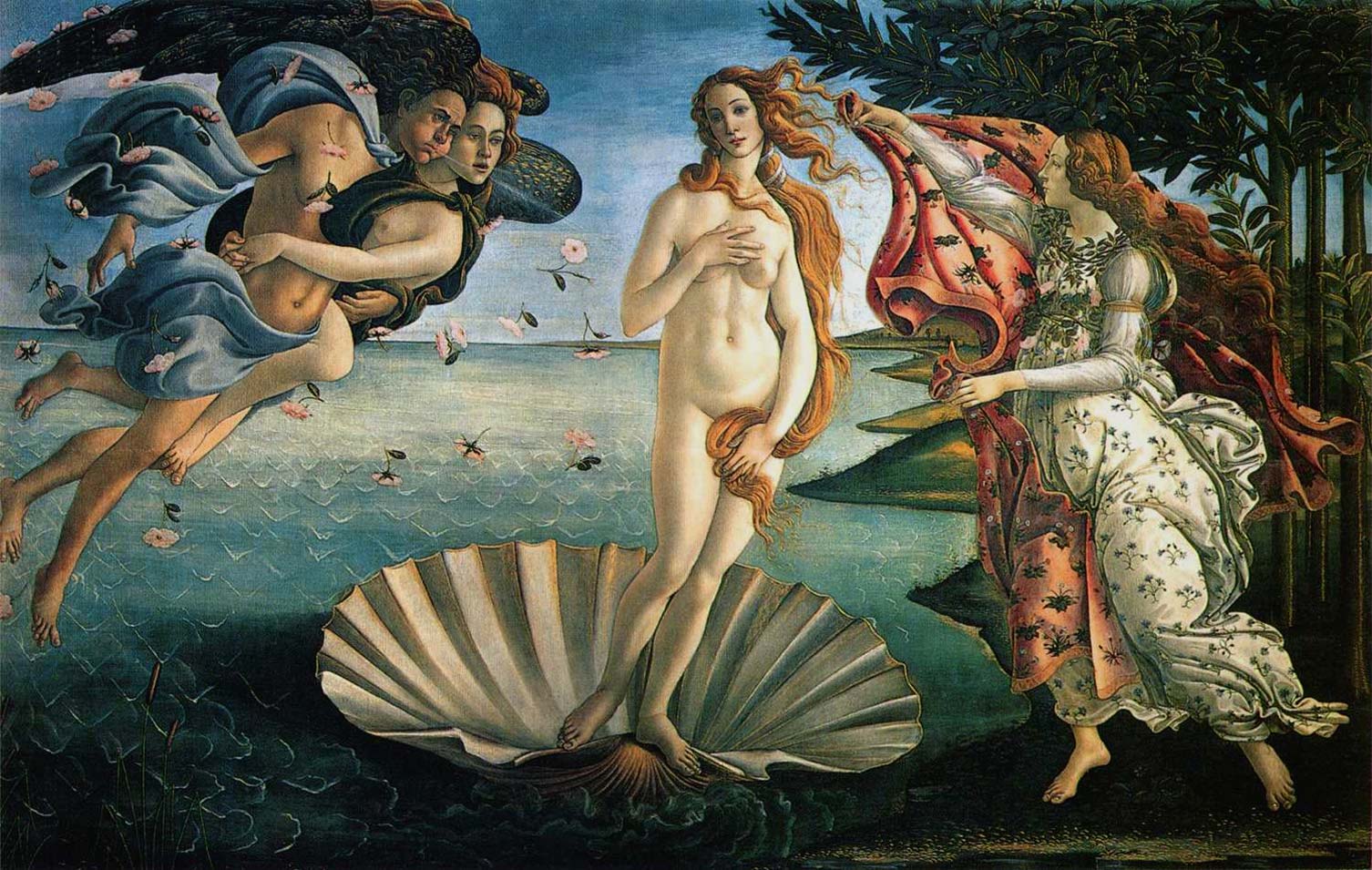
Naturally, there are positive and negative forms or deployments of production. The "good" and the "bad," as determined by our reason and perceptive senses. Hence, the poetic turn of phrase and the banal imprecation, the lovely song and the out-of-tune piano, Nabakov's Lolita and the propaganda warfare manual, the mythical cure for cancer and the wonder-weapon of biological warfare, and so on. It follows that classifications of good and bad depend on the perspective (Lolita as poetry or morally deprived rot (to, say, the cultural reactionary), the biological weapon as good for inventor bad for foe, etc.). And questions of scientific advancement depend on an idea of advancement. Progress is highly contested. Even art, whose pulchritude is the most clear-cut example of innocent production I can think of, is contested and controversial. It is a grab-bag, widely encompassing, and incapable of escaping its social and human influence. Therefore, Botticelli's "The Birth of Venus" can be seen as a symbolic masterwork or pornographic, anti-Christian mythology. The above examples serve to illustrate the inherent duality of things, which qualifies only as a digression in this tract. I press on.

Taking as given that production should be "good," without tackling the question of what is good and what is bad, I suggest that production should be. I mean, people should produce, and those with more brainpower, artistic talent, energy, or any other productive force (which can all be, to some extent, developed and honed during life), should produce more. This makes for a more beautiful, richer, more interesting and inspirational world and society to inhabit. Channeling potential energy into the kinetic energy of construction, formation, manipulation provides the stuff which enkindles the spirit. Art and functionality coupled engender enrichment and amelioration.

The second part of the puzzle has to do with need. Human beings have material needs for the avoidance of death. We also appear to have social needs, such as acceptance, flourishing interpersonal relationships - in short, to love and be loved - ego-based needs, such as self-esteem, and cognitive and creative needs - we need to stimulate that gray and white matter. We need to exercise these functions in order to be "complete" human beings - to sate physical requirements and retain self-awareness, ego, cognitive function, and aesthetic sensibility.

Needs imply consumption, but I argue that they are not fully comprehensible except in conjunction with production. Consumption occurs for the sake of production. Production is naught without the fuel of consumption. However, consumption for the sake of consumption is also gratifying. Food and drink are the most immediate and accessible example - they cause pleasure. Their gobbling and glugging represent a cornerstone of the Epicurean philosophy. In addition to being desirable and pleasurable in their own right, consumption of food and drink can be purposive - directed at production. They are literally fuel and produce the energy from which all action is dependent. They can be shared, they lead to merrymaking, they are necessary. As in all things, moderation is counseled, and minimizing consumption while optimizing energy and happiness outcomes is ideal. The hedonic treadmill illustrates the point. The principle of the hedonic treadmill is that, despite increased consumption, greater happiness is not usually achieved, because, among other things, rising and mutating expectations and desires raise the stakes ever higher. Happiness has surprisingly little to do with the amount of consumption, though there is obviously a lower bound below which squalor implies such deficiency that needs are not met and happiness is elusive. I propose the principle that minimizing consumption of all things while maximizing production is the optimal model for human life.

Minimizing consumption while maximizing production is a lot like "producing more with less." Productivity is key, but so is a sense of justice, need (as opposed to want), and a recognition of the value of production. Justice implies sharing the communal endowment, giving recognition where it is due, repaying debts and dues, while valuing production means recognizing that it constructs and determines our world. A person whose consumption outweigh's their production is a leech on the productive capacity of the planet and the output of others. He or she or it whose production supersedes their consumption has a net positive effect on the world - makes it more gorgeous, more interesting, more pleasing. It seems unlikely that the exchange of consumption and production is one to one. Which makes the enterprise of comparing production and consumption vectors dubious. It is obvious, however, that more production of "good" or positive ideas, artwork, constructions, and actions, results in a more variegated planet, and that we are the communal benefactors of that production. Many productions are, in economic terms, non-rival and non-excludable, meaning it is difficult to obviate the addition of consumers, and the cost of adding an additional consumer is close to zero. Goods which are like this include murals, bridges and dams and other infrastructure, public benefits of education, music and architecture and artistic flourishes to functional constructions, books and libraries, parks, etc. In this way, a person or a small group can produce something whose benefits permeate, unbounded. The rule of thumb: Produce more, consume less.

To put it into perspective, I subject myself to the magnifying glass: What do I produce and consume? For one, I have been undeniably and continuously dependent on my parents my entire life. They satisfy my material needs, whose satisfaction has allowed me to pursue creative, intellectual, and leisurely pursuits of all stripes. They foot the bill, they nurture, they voluntarily enslave themselves to my whims. What do I give back? My progenitors certainly reap some amount of satisfaction from having produced and raised me (Indeed, I am quite stupendous). That was their goal; that it is and has come to fruition in multifarious ways must be a source of great joy and wonder for them. Not only that, but I remain close to them. I am their friend. I love them. The bond between us is mutually or communally produced. The social unit made up of people is one of self-evident interdependence, whose purpose is to satisfy all members and contributers. This unit is part of a self-sustaining and repeating system. I produce the extant unit through belonging and playing my part, and further down the line I am expected to perpetuate the social construct with my own family and offspring, and so on and so on. I consume food, drink, shelter, security of mind and body. I produce thoughts, my brain builds synapse bridges, I develop skills and objective-driven capabilities. I make art sometimes, or all the time, I influence those around me with my words and actions (as they, in turn, influence me). I prepare for the future. I am an investment; my parents and I, my friends, my teachers, and the society are investors in my human capital. I work and produce to pay dividends and repay them their dedication and contribution to my personal development. Work is production, and work has as many guises and purposes as can be formulated by the fecund imagination.

It would appear to be a shame if, with all of the tangible and intangible investments in me, I turned out to be a wastrel, a rogue, or a self-absorbed, thankless jerk, refusing to take responsibility for all that has been given (produced for) me. I am modest about what a good life is, but there are many iterations of a bad life, many of which can be characterized by an improper or unhealthy consumption to production ratio. Consider the layabout, the highly capable welfare recipient, the larcenist, the Paris Hilton, the destructor. A life leaning immoderately towards consumption might appear to be desirable, but it is lacks fulfillment. It does not stimulate the social, creative, and cognitive - the productive - areas of our being.

Happy New Years!
Resolution 1: Produce more, consume less

Friday, September 25, 2009

Gone on (economic) growth

Nobel prize-winning economists, Joseph Stiglitz and Amartya Sen are rejecting the notion that GDP growth is THE index for measuring economic and social well-being. They posit that perhaps we have lost perspective; in the quest for growth maximization, other valued objectives have become obscured. One thing is sure: the growth game is hegemonic. It is also adversarial and limited. It makes one think of body-height eating-capacity competitions.

Clearly, the tallest or largest person is not necessarily the healthiest or happiest (indeed, gigantism is a sad, crippling disorder - just ask André the Giant). Likewise, those that can gobble the most chicken wings or cherry pies suffer sickening after-effects: a swollen lethargy, ache, and purge. The meltdown of our culture of gluttony and growth obsession has made us familiar with these sensations. Economist Bernard Baumohl informs us that, prior to the self-inflicted butt-kick, only 65% of what we bought was actually bought. The rest was paid for Dumb and Dumber style, with a fat fistful of IOU's.

It appears that the collective of U.S. American consumers has tunnel-visioned its way into perpetual short-sightedness. Either consequences are too far off to be seen as relevant or we suffer from a societal cecity. The "shameless stuffing while others starve" which Walt Whitman criticized in his 1855 American Epic, Leaves of Grass, is a characteristic aspect of our culture. Darwinian survival of the fittest has taken a backseat to Teletubbian survival of everybody. It might just be that Newton's laws have been conquered by macro-management: causes have been divorced from their effects. AIG stands like a smirking sentinel; the smiling Buddha, complacent and stuffed with greenbacks.

Of course, there were woeful economic effects to the world's most recent price over-evaluation depreciation (bubble-burst). Economic pain is of preeminent concern. However, justice is also principally important, and we likewise know that the spoiled child learns naught. Misbehavior unpunished is misbehavior reinforced. The child, gremlinlike, nurtures his demand, grab, and guzzle mechanisms.

We are stuck with the moderated disincentive which Bernanke and Paulson's meddling has left us. The best we can do is allow the ugly effects of this current downturn to be educating and therefore salubrious. I mean, we should learn from our mistakes. I submit that if the moderated downturn-caused pain is enough to teach us prudence and temperance (for a while, at least) then the effects of this recession are sufficient; if not, they were not enough. We are the spoiled consumer child and China is the currency-devalued consumption-pusher.

We should also recognize that the GDP-growth-centered model has proven to be poisonous and limited. The S-twins (Sen and Stiglitz) and their sidekick Sarkozy (who commissioned their report) propose a solution, or at least an alternative. They are advocating something like the Gross National Happiness (GNH) index, long used in Bhutan. Their sophisticated index would consider growth, of course, but only as one of a number of key variables. Also included would be education and health indices as well as considerations of real wage. The S-trio may be on to something.

Of course, economic theorists have long recognized the relevance and value of other indices. Regrettably, quantitative measure of those mechanisms continues be prohibitively difficult. Economics models center on self-interest and growth because isolation of those effects (even though they over-simplify the huge complexity of human behavior and preference hierarchies) reveals useful empirical information.

The problem, then, is not the use of caricature-style models, but the hegemony of those indicators. Inimitable economic and otherwise analysis utilizes the qualitative and qualitative; in this case, focusing on empirical growth data and culture. The truth of the matter is that close examination of one or both of these instruments should have revealed intrinsic lack of sustainability in the socio-economic culture of the pre-"Great Recession" years.

For less-developed countries, the growth game (coupled with the S and S model) continues to be integral. For the United States and the other rich countries, it has lost its utility. Growth in order to fuel unsustainable excess and global inequality should finally appear less than appetizing, especially when we have to overvalue our assets or go to war to achieve it. We need to figure out what is important, and how to go about getting it and instilling it in our culture.